





Our People to Live Stronger & Longer

Have your say on remote food security

The Australian Government is in the process of developing a National Strategy for Food Security in Remote First Nations Communities in a partnership with state and territory governments and First Nations health organisations. 

To gather genuine insights from our communities to influence the final strategy, the Australian Government, along with state and territory governments and First Nations health organizations, is actively seeking feedback from stakeholders and community members. 

You can contribute to the consultation process via face-to-face consultation sessions or online submissions. NSW has been allocated one face-to-face session which will be facilitated as a ‘Hub Forum’.  

“Food and Water for Life” initiative by Dhariwaa Elders Group and Walgett AMS has been recognised by the National Strategy and will be used as a case study to shape the final strategy.

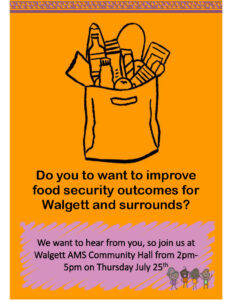
The NSW ‘Hub Forum’ is scheduled to take place in Walgett on July 25th, at the Walgett Aboriginal Medical Service Community Hall from 2:00pm to 5:00pm. The ‘Hub Forum’ aims to gather local perspectives and recommendations from the community and will be a great platform for all who would like to voice the challenges and what works for your community. 

Although the National Strategy is mainly focused on the remote and very remote areas, we are aware that food security is a challenge to many regions regardless of the remoteness level across NSW. Thus, we believe all your genuine feedback is essential for a better and a feasible strategy to best support our community. 

Should you wish to attend the Hub Forum at Walgett, please register through National Strategy for Food Security Hub Forum Registration.

For those unable to attend the forum in person, please do participate in the online submissions and give your feedback on the discussion paper to represent your community, challenges and opportunities to improve through the National Strategy.  

Online submissions are currently open and will remain open until August 11, 2024. Direct submissions can be sent via email to RemoteFSConsultations@niaa.gov.au

If you do not wish to submit online but would still like to give feedback, please reach out to publichealth@ahmrc.org.au, and we are happy to advocate for you at the national platform for the food security strategy.

Mental Health Survey – Findings

We would like to give out a big thank you to all our member services who supported us by submitting the mental health support for flood affected areas survey.  

With your support we were able to gather some valuable information which guided us understand the challenges faced by the ACCHS post 2022 floods, challenges the community experienced and experiencing, and the support needed for the ACCHS to improve mental health of those who were affected by the 2022 Floods.

90% of the contributors expressed a surge in seeking mental health support following floods and thankfully, the majority of ACCHS were able to offer a range of mental health services to community members in need including referrals to external mental health services.  

The indicated challenges for the ACCHS when providing services were staff availability (32%), telecommunication disruptions (18%), Increased demand beyond capacity (16%), damages to their healthcare facilities (13%) and lack of resources (9%) and other minor issues (10%).   

The reported responses show lack of available appointments (36%), transportation issues (27%), nonoperational services (12%) and telecommunication barriers (12%), lack of information on available services (6%) and Other minor issues (4%) when making external referrals for the mental health services.  

Barriers in seeking help, prolonged wait times, transportation challenges, gap costs, limited availability of specialist services and staff, lack or culturally sensitive services and resources were stated as the challenges faced by the flood affected communities.  

We’ve also taken note of the recommendations provided in the survey regarding the services and resources necessary for an improved response to community needs. 

AHMRC will be committed to exploring improved methods to assist our member services in delivering improved mental health care for our community affected by the 2022 floods.   

Regional SEWB Community Workshops 

  • Workshop 1 Port Macquarie: 20th and 21st August 2024
  • Workshop 2 Nowra: 3rd and 4th September 2024
  • Workshop 3 Dubbo: 15th and 16th October 2024
  • Workshop 4 Tamworth: 5th and 6th November 2024

Age Lowered for Bowel Cancer screening – screen from age 45

From 1st of July 2024, the eligibility for bowel cancer screening age has been lowered to 45 years of age. All adults 45 and over can now join the program and screen for bowel cancer.  

Eligible individuals 45-49 years can register through the National Cancer Screening Register to receive their first Home Test Kit delivered to their home and continue to receive testing kits every two years. Those from 50-74 years will continue to automatically receive their kits every 2 years. 

The ‘Alternative Access’ to bowel cancer test kits is open for ACCHOs to bulk order kits through the National Cancer Screening Register Health Care Provider Portal. When you are yarning to patients about screening, having kits on the spot makes it easier to encourage patients to do the test.   

Let’s help get everyone from 45 and over to get registered and screened early to increase participation rates in your community. 

This short video explains how to order Bowel Cancer screening tests:  How to bulk order bowel cancer screening kits – Healthcare Provider Portal walk-through guide 

A useful video to show patients explaining how to do the test is available to watch on Youtube: How to do the test – Indigenous bowel screening (youtube.com) 

NSW ACCHOs Drug Alerts

Nitazene is a synthetic opioid that is up to 10 times stronger than fentanyl and up to 500 times stronger than heroin. Only a small amount of Nitazene can lead to an opioid overdose  or death and has been responsible for many deaths and overdoses in Europe and North America.  

Nitazene has now been detected in Australia, with devastating consequences. 16 – 18 deaths in Victoria are suspected to be from Nitazene use and 4 severe opioid overdoses requiring hospitalisations in Sydney are confirmed to be from this new drug. 

It has been found in vapes, MDMA, ecstasy tablets, cocaine, heroin and may be used in other illicit drugs commonly used. Illicit drug use has never been more dangerous in Australia, and ACCHO healthcare workers should be aware of this new threat and the potential danger it poses to their clients. 

More information about the risk is available in the Public Drug Warning on the NSW Health website. 

Naloxone is an Effective Treatment for Opioid Overdoses and available free of charge.

The NSW Government offers to supply ACCHOs with Naloxone to dispense to clients and their carers free of charge. 

Take home Naloxone is a life saving measure which can temporarily reverse an opioid overdose, including with Nitazenes. Nitazenes can last longer in the body than heroin and naloxone. Higher and repeated doses of naloxone are often required as well as hospital treatment. 

Because Fentanyl and Nitazene are often added to non-opioid illicit drugs, such as ice, and MDMA, anyone using illicit drugs is strongly advised to carry keep Naloxone with them and keep at home just in case they take a substance containing Nitazene or Fentanyl.

Take home Naloxone is available as an easy-to-use nasal spray or injection from some pharmacies and other health services. You can watch a webinar explaining how ACCHO’s can be involved in the take home Naloxone program on the AH&MRC website: Watch the webinar here.

For more information on Naloxone or where the nearest pharmacies with Naloxone nasal sprays are located visit: Your Room – Naloxone​ 

NSW Health Alerts – Gonnorrhoea and Mpox

Gonorrhoea with Antimicrobial Resistance (AMR)  

NSW Health Alert was released in response to the increased detection of Antimicrobial Resistant (AMR) Gonorrhoea within NSW Gonorrhoea notifications.

Gonorrhoea is a standard request for all Asymptomatic STI Screening together with chlamydia, HIV, syphilis and Hepatitis B (if status not documented in the patient’s medical record).  

However, it is essential that with increasing resistance to current first-line Antibiotic treatment for Gonorrhoea, that a gonococcal culture is collected for each positive case BEFORE treatment to ensure that all AMR Gonorrhoea is identified and adequately treated. 

For all treatment, management and contact tracing guidelines refer to The Australian STI Guidelines, contact your nearest Sexual Health Clinic or the Sexual Health Information Line (SHIL). 

New mpox cases detected in NSW 

8 mpox cases have been confirmed in recent weeks in NSW, some have been linked to an outbreak in Victoria, but local transmission has also occurred. 72 Mpox cases have now been identified in NSW since May 2022.

The latest NSW Health Alert is available via this link which gives a guide on symptoms to look out for and who to test. Anyone who exhibits symptoms of mpox infection – or who has had close and not necessarily sexual contact with a confirmed case – should be tested.  

In NSW, Mpox vaccine is recommended and free for all sexually active gay and bisexual men (cis and trans), sexual partners of these people and sex workers.  It is important to note two doses of vaccine are required, at least 28 days apart.  

To find clinics offering the vaccination visit the NSW Health website. 

ACCHO Request for RAT/PPE

Since the closure of the Government Stockpile for COVID-19 resources, AH&MRC has been able to support our members with ongoing access to the supply of RATS and PPE for their communities. However the AH&MRC short-term funding for supply of RATs and PPE to our members will has now concluded.  

During this transition period, we hope that you have established your own supplier pathways for ongoing access to these resources. If you have been unable to secure these pathways, please get in touch with us at Publichealth@ahmrc.org.au  

In addition, we have access to Gloves: Size: Large, Expiry: 7/2025.

If your service is interested in obtaining a carton/s (1000/carton), please email Public Health with your contact details, including name and position with delivery address and we will ship to your service. Carton numbers are limited. 

“Now’s the Time” Flu Vaccination Resources

The cold months of winter are here, and it is more important than ever to make sure our patients are up to date with vaccination, Vaccination will help keep our communities well and prevent severe illness from  respiratory infections. 

We have seen many admissions in NSW hospitals from influenza and other respiratory illness and it is young  children who are becoming severley unwell and being admitted into hospital.   

AH&MRC’s ‘Now’s the time’ resources have been created to help raise awareness and encourage everyone over 6 months of age to have the flu vaccination in 2024. 

We hope you will display these posters in your ACCHO and beyond, to spread the word that flu vaccination is one of the ways we can keep ourselves, our families and the whole community well.
Posters and web banners are available on the AH&MRC website and hard copies of these resources are available upon request.

Community poster
Elders poster
Mums and bubs poster
Pregnant mums poster 

Log in to your Members Dashboard to put in an order on the shop and receive a free poster pack delivered to your ACCHO. 

Vapes now prescription-only

As advised in the January article Reduced access to vapes coming – is your ACCHO ready? the government is continuing to introduce additional regulations in an effort to control access to recreational vapes.  

Therapeutic Goods and Other Legislation Amendment (Vaping Reforms) Bill 2024  has now passed which cracks down on the sale of all recreational vapes in Australia and there is restriction on advertising, packaging and flavours for vapes. 

Since Monday 1 July 2024, ALL vapes in Australia are only available at pharmacies. This means it’s illegal for any other retailer, including tobacconists and convenience stores, to sell any type of vape or vaping product. Individuals who have a vape on them for personal use will not be targeted under the changes to the laws. 

Until 30 September 2024, everyone will need a prescription from a doctor or nurse practitioner to buy vapes that contain nicotine. 

From 1 October 2024, people 18 years or over will be able to buy nicotine vapes from pharmacies without a prescription. People under 18 years will still need a prescription. 

You can find out more about the changes to the regulation of vapes on the Therapeutic Goods Administration (TGA) website.  

Vaping is considered a second-line quitting aid for smokers who are unable to quit with first-line treatments. There is Information for prescribers available with links to the Special Access Scheme pathway which simplifies prescription access to therapeutic vapes where clinically appropriate.  

The following additional resources may help ACCHO’s staff who are supporting clients seeking help as a result of difficulty accessing vapes: 

The following resources are for patients, parents and carers:  

AH&MRC are committed to supporting smoking and vaping cessation in the community and will continue to provide funding for NRT to our member services. We are also working with stakeholders to explore training options for delivery of smoking cessation training across ACCHOs. 

Please reach out to asavidis@ahmrc.org.au or publichealth@ahmrc.org.au if you would like further information. 


AH&MRC Announces Appointment of New Chair and Deputy Chair

The Aboriginal Health & Medical Research Council (AH&MRC) is pleased to announce the appointment of Jamie Newman as the new Chair and Kristine Falzon as the new Deputy Chair of our organisation.

Read the full Media Release.

Every Yarn Counts

Come and have a yarn about hepatitis C treatment. Treatment for hepatitis C has changed and is easier than it’s ever been before. It’s a cure, all it takes is one to three pills a day for 8-12 weeks to live free of hep C. Curing your hepatitis C means you don’t have to worry about passing it on to your partner, friends or family. Look after your mob.

Treatment has changed and is easier than it’s ever been before. All it takes is one to three pills a day for 8-12 weeks to live free of hepatitis C – No more injections.

The treatment also has way less side effects. Over 95% of people clear hepatitis C from their body with the new treatment (a cure). A doctor or nurse can prescribe treatment, and support is available from start to finish. Treatment costs are covered under Close the Gap too.

Treating hepatitis C earlier rather than later can stop the liver from being damaged.

Every person’s experience of treatment is different. Some people don’t know that hepatitis C can make them feel foggy and have low energy. Being cured can help to make them feel better. Some people feel like they have more energy after being cured. Other people just love not worrying about hepatitis C because they can’t pass it on.

The good news is, if you get hepatitis C again, you can be cured again (and again). Simple as that. It’s good to know that once you are cured, you won’t pass it on to anyone else. You’ll be looking after you and your mob.

If you have already been cured, it’s important to stay blood-aware because unlike some other infections, your body doesn’t protect you from new infections. Hepatitis C treatments are not a vaccination and do not protect you from getting hepatitis C again.

The only way to know if you have hepatitis C is to have a blood test. You can ask your Aboriginal health worker, nurse or doctor for the test, or you may like to have yarn about a hepatitis C test at your annual (715) health check. The health check is free of charge and can be accessed by all Aboriginal and Torres Strait Islander people.

If you have hepatitis C the next step is to have a yarn about treatment and cure. The cost of treatment is covered under Close the Gap.

Take the first step, have a yarn at your local Aboriginal Health Service today. Every Yarn Counts.