



Our People to Live Stronger & Longer

Connected to Country: #CommunityControl success stories at Galambila

As bushfires and heavy smoke plagued the NSW mid-north coast, Galambila’s connection to Country and community shone through.

For weeks last year the skies over Galambila were “almost apocalyptic” as devastating bushfires continued to burn nearby, threatening local community members on the other side of the coastal highway in northern New South Wales.

By day and by night the sun and the moon glowed blood red as acrid smoke lay low and dark over the area, exacerbating respiratory issues and raising longer-term health and safety concerns for a summer that was still to come.

As coordinator of Ready Mob, the Tackling Indigenous Smoking program at the Galambila Aboriginal Health Service at Coffs Harbour, Tyson Morris is usually focused on a different sort of smoke.

But this had been a devastating and early start to the bushfire season.

“The amount of smoke up here is really hazardous to health,”

he reported, as the bushfires burnt into their second week and the tropical region had gone without rain for more than a month.

“You can hear it in people when they walk in, they’re really shorter of breath. I feel it myself.”

Galambila rallied in response to this early season emergency, rescheduling appointments in case acute demand grew and setting up rooms with ventilation.

Morris and others took to social media, getting messages out to community via Facebook particularly on the need to be prepared and stay safe: to leave if urged to do so by emergency services, and to be mindful of their mental and physical health as the bushfires burnt on.

Morris is a Gumbaynggirr man, born and bred in the area around Coffs Harbour, where the Great Dividing Ranges meet the sea.

“We all take pride in the area,” he says of the 3,500-strong local Aboriginal community served by Galambila, which in late 2018 marked its 20th anniversary and the arrival of new CEO Reuben Robinson, previously a long-standing board member.

Its response to the bushfire risks is a measure of how Galambila seeks to work: connected to country and community and looking to prevention, primary responses, and to the long-term on a range of health issues, be they physical, social, emotional or environmental.

It also has a strong focus on the wellbeing of its own teams, Morris says.

“The working environment here is a really healthy one,” he says. “There’s a lot of support internally here for our staff and our team members. It’s a place where you can feel you’re valued.”


Boosting checks

Galambila’s approach, and the healthy dose of humour it brings to its work, has contributed to outstanding successes in recent times.

Clients sitting in the waiting room have been able to track the progress of the service’s innovative efforts to boost kidney health checks and flu vaccinations, egged on by plenty of puns and caricatures of staff to literally put a face to the messages.

“That really connected with community,” said Galambila chief pharmacist Chris Braithwaite, who is also leading the service’s quality improvement and clinical governance work under the Enhancing Mob Health Using Data (EMHUD) program.

The program, which maps and tracks a suite of national KPIs to identify areas for improvement in terms of how Galambila delivers services, identified in 2016 that rates of flu vaccination uptake among the community were low.

A subcommittee was formed with representatives of all teams – from reception and finance through to clinical and administration – to come up with strategies to improve uptake. This ensured input and buy-in across the organisation.

Strategies included fun and funny health promotions, plus internal action such as a Myth Busters for all staff that aimed to address mixed messages and myths that were preventing people from vaccinating.

It saw Galambila double its vaccination rate over two years, from 586 in 2017 to 1083 by the end of 2019.

Inspired by the results, the service took a similar approach this year to kidney health checks. In mid-2017, Galambila’s rate was “sitting at around 10 percent of eligible people” screened over the past two years, Braithwaite explains.

Two years on, it’s at around 45 percent of that population now, more than double the state average of 20 percent, “so we’ve done really well, relatively,” he says.

“If someone comes in with a sore knee, you tend to just focus on the sore knee, but because we had had all these broad discussions that helped elevate kidney health into our minds, we made sure to raise the need for checks in consultations with those patients who were eligible.”
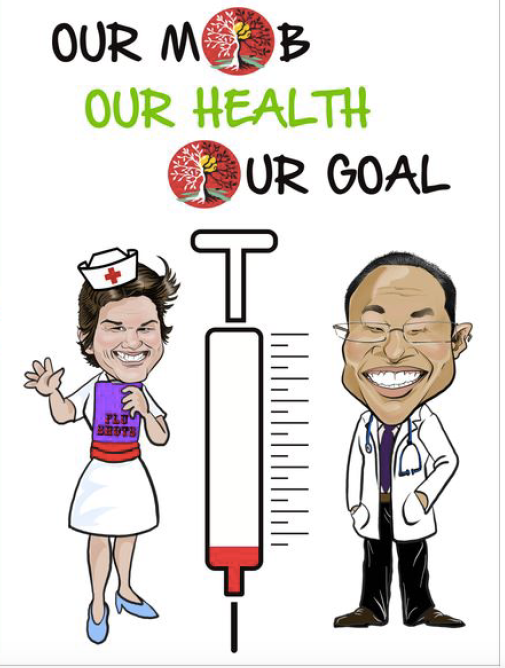
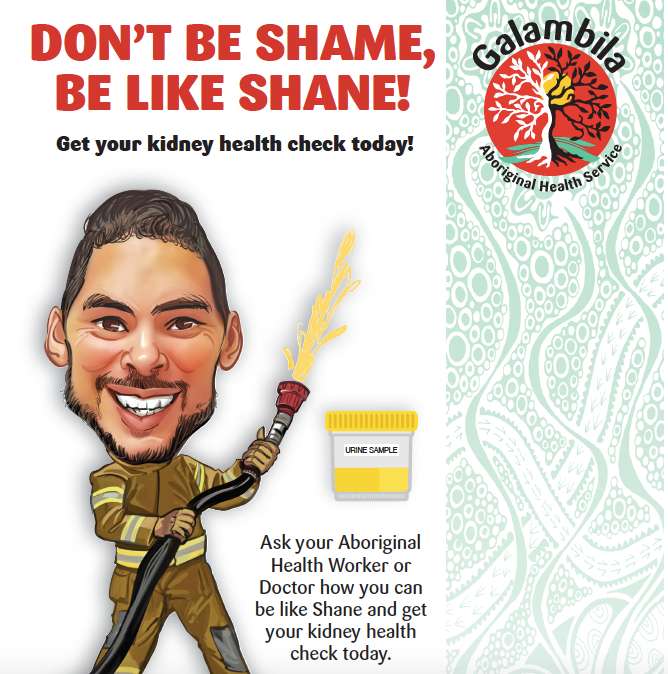
Galambila’s approach, and the healthy dose of humour it brings to its work, has contributed to outstanding successes in recent times. Image credit: Galambila


Ngiyaa Ngiimba Minya Ngiinda Julu-Ngarraangi. We all ask what you think

Galambila is now reviewing its approach to Health Assessments and has formed a partnership with the Bulgarr Ngaru Medical Aboriginal Corporation in Grafton and the Werin Aboriginal Corporation Medical Clinic in Port Macquarie to form a regional strategy, “recognising we’re all stronger together”.

A community survey done as part of the review process has generated rich insights, resulting in a ‘four pillars’ approach to Health Assessments, considering the perspective of the patient, the population, the service and the workforce.

A key message from the community, which is now being embedded into responses, was that they wanted a bigger focus on social and emotional wellbeing, as well as physical health.

Galambila has also consulted closely with the community on mental health, looking in particular to make RUOK Day more meaningful and effective. It sought advice from the local Elders’ group on culturally appropriate ways to approach mental health concerns, and what language to use.

The result? A response that’s community-led rather than generic or mainstream and where – again, unsurprisingly — humour has been key.
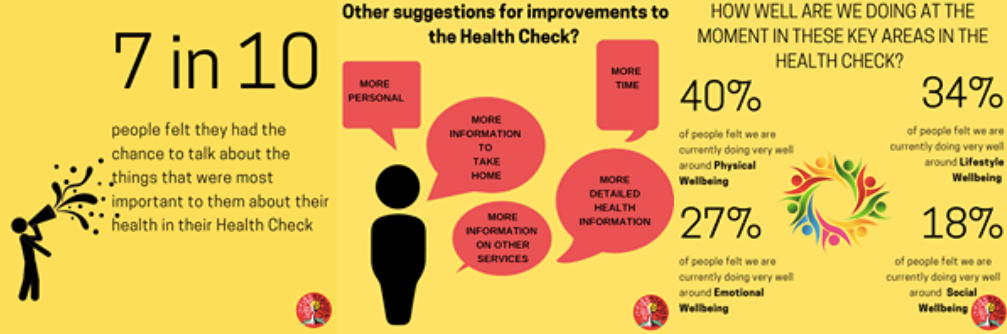
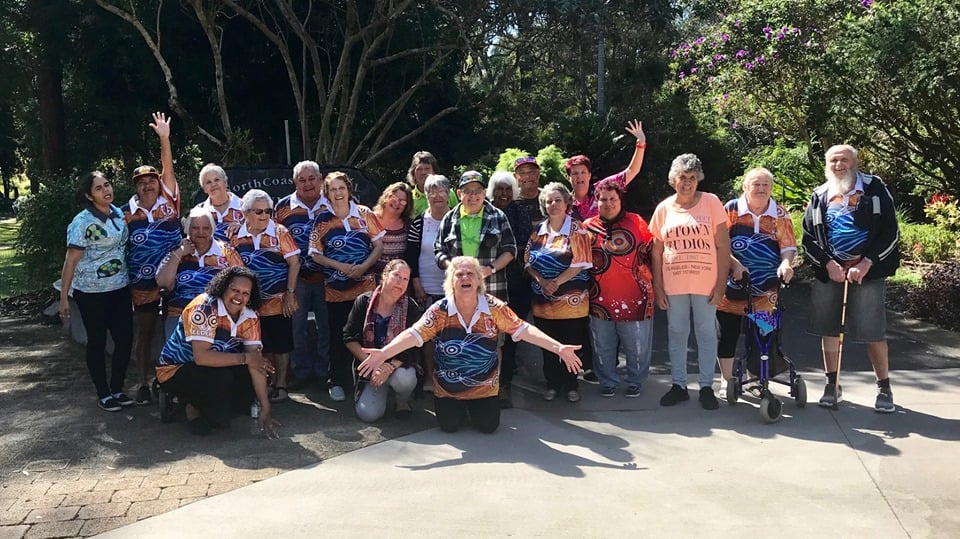
Community-led responses with close engagement of elders and a healthy dose of humour are key to Galambila’s success. Image credit: Galambila


Ready Mob: finding triggers that work

Mr Gross Mouth often does the talking for Ready Mob’s Tyson Morris, graphically depicting the effects of smoking: dried lips, ulcers, cancers, a ‘furry’ tongue from the settlement of tar and plaque, and gingivitis.

“I like to put a lot of humour into it, that’s how I like to deliver sessions,” says Morris of his larger-than-life prop.

Ready Mob (which stands for Really Evaluate And Decide Yourself – Make Ourselves Better) delivers hundreds of Smokerlyzer tests at events throughout the region, from sports fixtures through to the Elders Olympics held this year at Port Macquarie.

Similar to a random breath test for alcohol, the Smokerlyzer measures the amount of carbon dioxide in a person’s bloodstream, providing some key and very personal statistics as to how addicted to smoking they are and, often importantly, how much that level of smoking is costing a year financially.

Morris has seen people give up “cold turkey, on the spot” at his education sessions. “One was 14 or 15 years old, I told him smoking can affect all different parts of your body, including your reproductive organs,” he says. “That pushed him over the edge.”
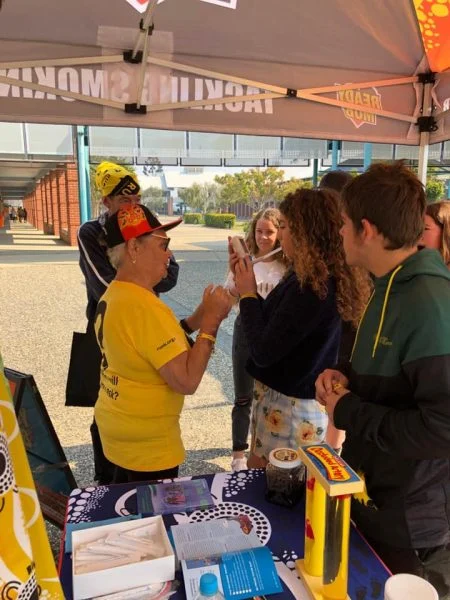
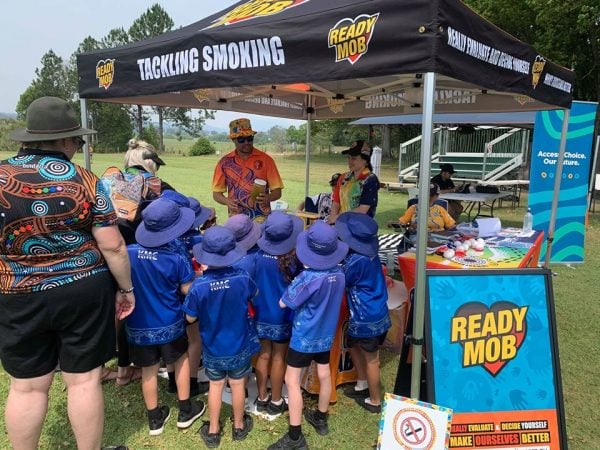
Ready Mob (bottom) delivers hundreds of Smokerlyzer tests (top) at events throughout the region. Tyson Morris has seen people give up “cold turkey, on the spot” at his education sessions, which use a mixture of humour and education, assisted by a larger-than-life prop known as Mr Gross Mouth (centre). Image credit: Galambila

Aboriginal Health Workers in focus

Tyson Morris – Aboriginal Health Worker, Ready Mob coordinator

For Tyson Morris, an interest in how the body works was sparked in his early 20s when he started exercising, body-building and going to the gym.

Seeing his own body improving, and in action, prompted him to apply for a job at Galambila as a health promotion officer, “my first Ready Mob job”.

After completing his Certificate IV in Aboriginal Primary Health through the Aboriginal Health and Medical Research Council (AH&MRC) Morris moved into clinical work, something he found both easy and rewarding.

Last year, he was thrilled to take up the Ready Mob coordinator role, where he gets to help empower community members to make their own informed decisions about health.

“It’s seeing people realise: ‘this is my health, my body, I’m going to do what’s best for me’,” he says.

Asked what his secret is, Morris says it’s about “the information that is provided and how it’s done. You can tell someone something but unless it directly correlates with them, they won’t necessarily pay attention. If you can customise it, then that can really hit home.”
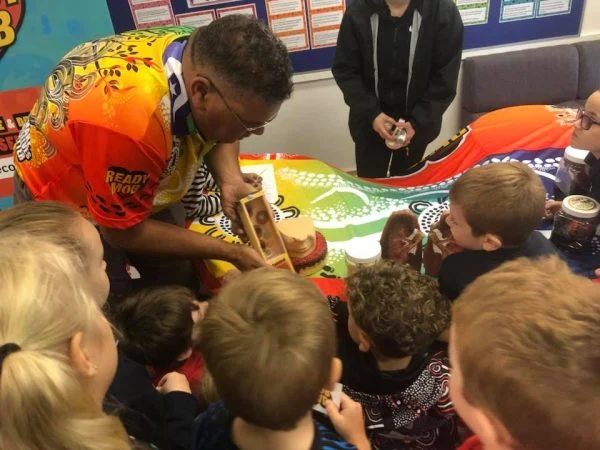
Last year, Tyson Morris was thrilled to take up the Ready Mob coordinator role, where he gets to help empower community members to make their own informed decisions about health. Image credit: Galambila

Michelle Sinclair – Aboriginal Health Worker

Michelle Sinclair is a Gumbaynggirr woman who has worked within community “since day one”, starting off in aged care.

She had always dreamt of working at the Galambila Medical Service: “because I’m a local, because I love the health sector and particularly because I have a passion about the health of our Elders, looking after them and giving back to them for what they did for us as we grew up.”

She leapt at the opportunity to start as an Aboriginal Health Worker, teaching herself to use computers, completing her Certificate III in Aboriginal Primary Health, and well on her way to securing her Certificate IV.

Sinclair is regarded by clients and colleagues alike as going “above and beyond” her duties, dedication that last year won her a prestigious prize in the Grace Roberts Community Development Awards. Named after Bundjalung woman Grace Roberts, who was a tireless community advocate, the awards celebrate those who have made a significant contribution to enhancing the quality of life of Aboriginal people in the Coffs Harbour area.

“Just seeing amazing changes that can happen for clients going through their health journey, when they can be empowered to live healthier lives, I love that, that’s what motivates me,” she says adding that clients are happy to come into Galambila when they’re sick because “they know they’re going to be well looked after”.

That also applies to staff, Sinclair says.

“We’re not co-workers, we’re more of a family here. We’re all here to support one another, we all work together because we know what’s most important is the client’s health. We all have that one goal: empowering our mob to live longer and healthier lives, to close that gap.”
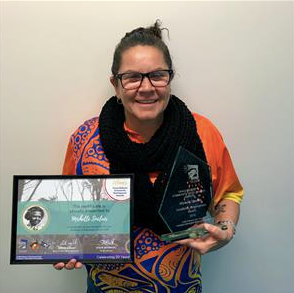
Aboriginal Health Worker Michelle Sinclair is regarded by clients and colleagues alike as going “above and beyond” her duties, dedication that last year won her a prestigious prize in the Grace Roberts Community Development Awards. Image credit: Galambila

This article is published by Croakey Professional Services as sponsored content. It was created in collaboration with the Aboriginal Health and Medical Research Council (AH&MRC) of NSW, which funded the #CommunityControl Success Stories series.

 
Written by

Marie McInerney, Croakey Professional Services

Edited by

Amy Coopes, Croakey Professional Services
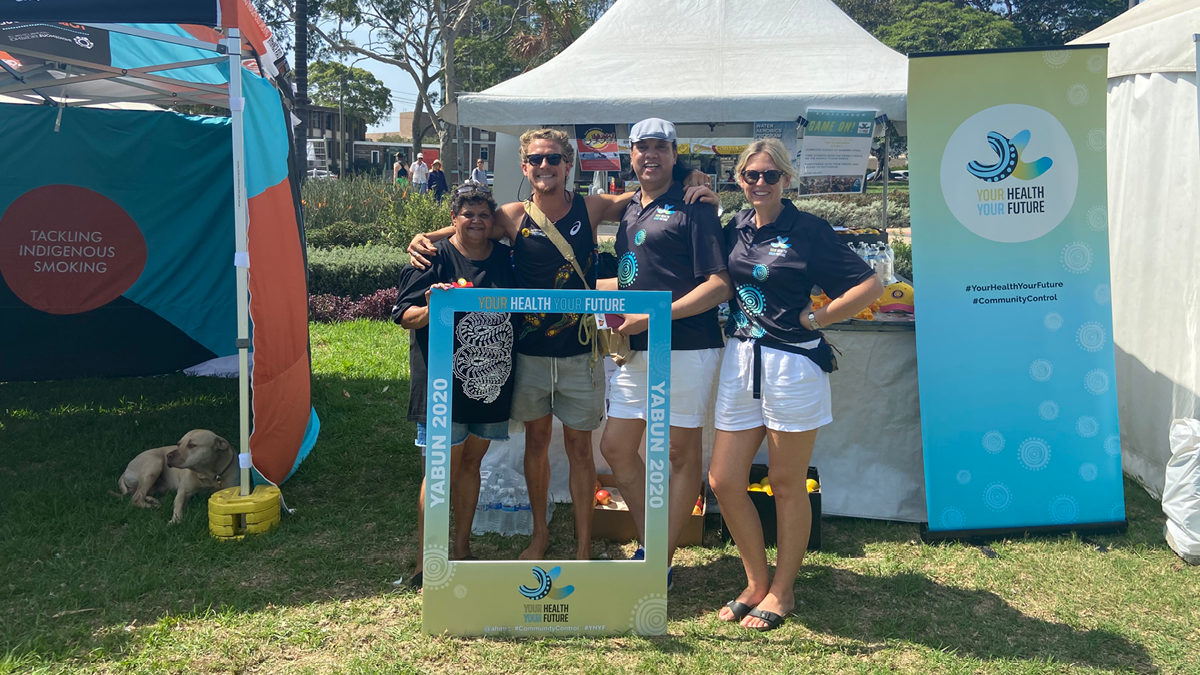
Spreading the message of health – Your Health Your Future at Yabun 2020

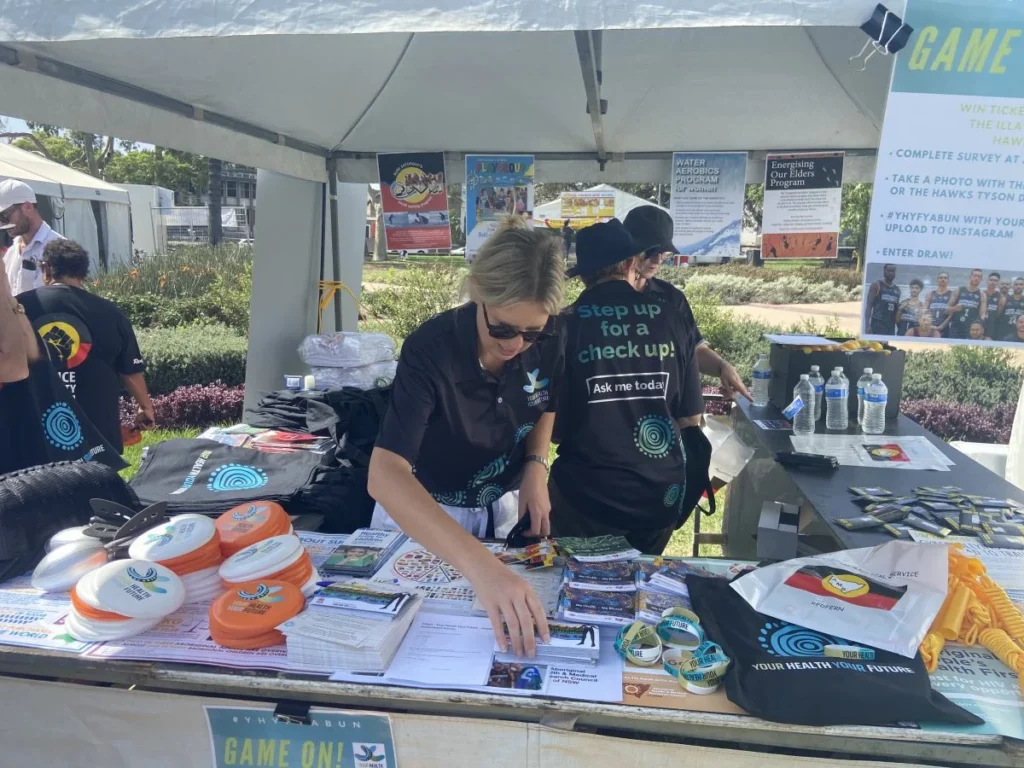
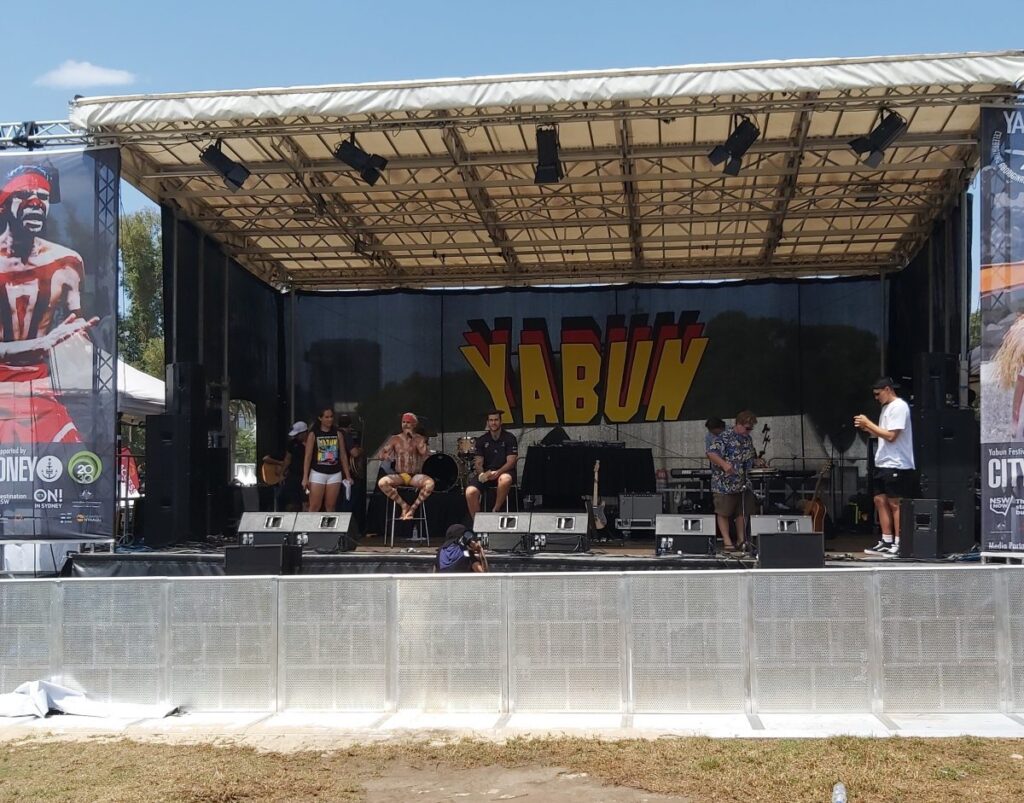
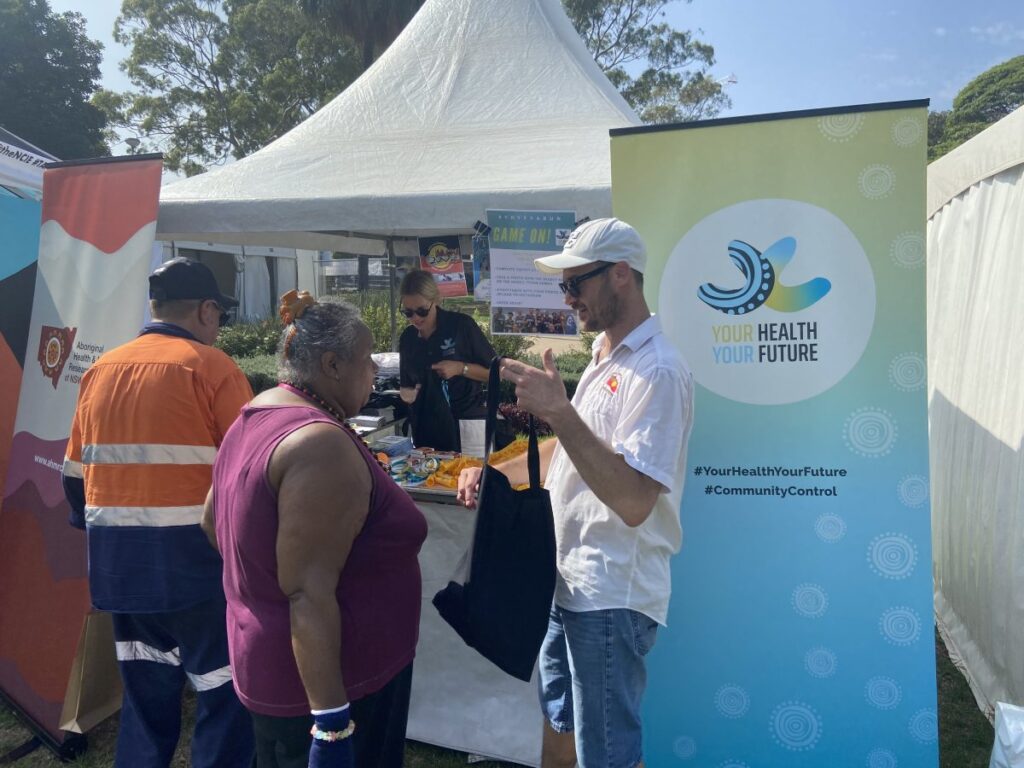
It was a sweltering day at Yabun, but none the less AH&MRC and Aboriginal Medical Service Redfern staff persisted in handing out resources and having a yarn with community members about health and the 715 health check. The stall was packed with merchandise when the festival started at 10 am but throughout the day stock dwindled and by our 3 pm pack down every hat, skipping rope, frisbee, bouncy ball, foam dart, wrist band and AMS Redfern goody bag had been given away.

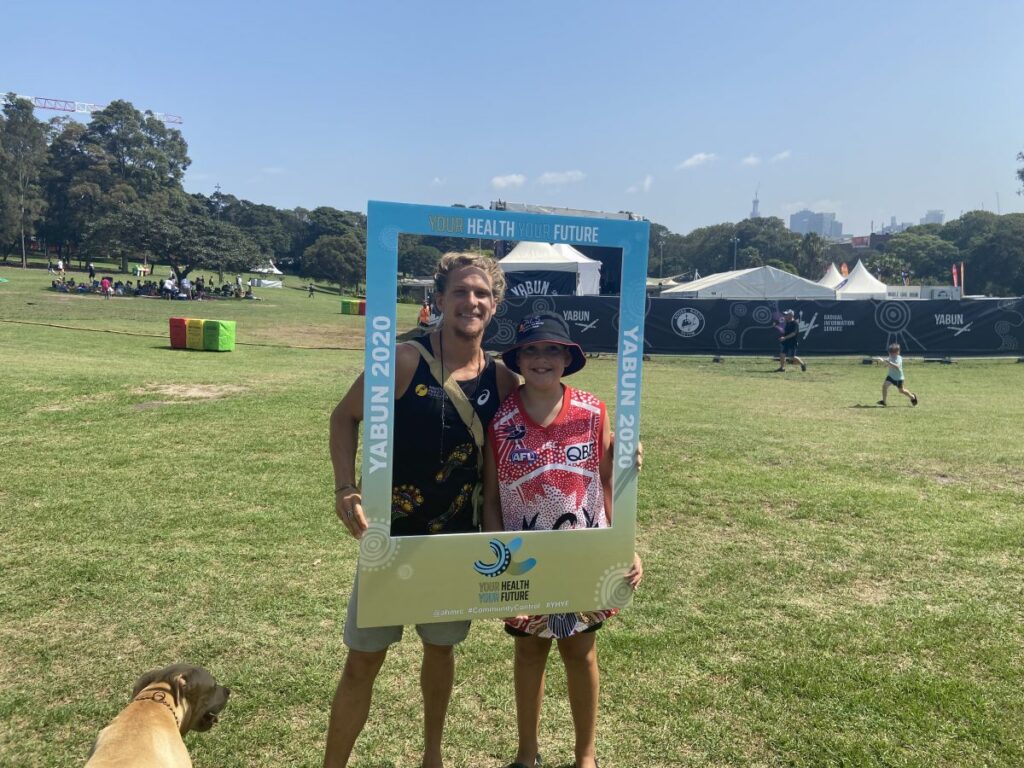
Your Health Your Future (YHYF) Ambassador Jack Wilson AKA the deadly ninja was hugely popular with festival-goers. Fans of Ninja Warrior stopped by the AH&MRC stall to have a yarn and take a photo with the deadly ninja and his adorable staffy, Bull. AH&MRC ran a Yabun Instagram competition which festival-goers could enter for their chance to win tickets to the Illawarra Hawks vs. New Zealand Breakers on the 2nd of February. The competition involved participants taking a photo with Jack inside a YHYF selfie frame and uploading it to Instagram with the hashtag #YHYFYabun. We have received several submissions and will select the winner in the coming days. Stay tuned!

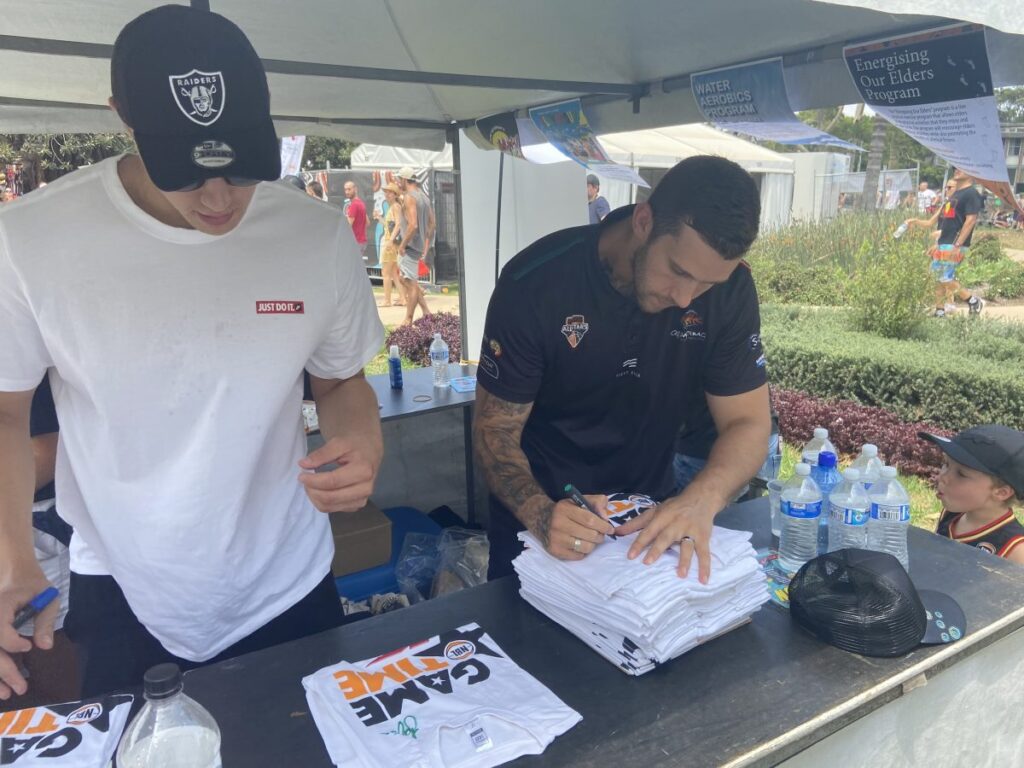
Our other YHYF Ambassador, Tyson Demos of the Illawarra Hawks, stopped by with his teammate after practice to drop off tickets for the competition winner, sign T-shirts and chat to community members. The signed T-shirts were handed out at the end of the festival along with the remaining merch at the AH&MRC stall.

Both Jack and Tyson got up on stage before at the end of the festival to have a yarn about their passion for health and giving back to the community. Their appearance on stage was sponsored by the YHYF Campaign and both ambassadors made a point of promoting the importance of getting a health check.

On the day, AH&MRC were collecting survey results from community members at Yabun to assess their knowledge of the 715 health check. Public Health Officers and AMS Redfern staff had a yarn with community members about the health check and directed them to their local AMS. The survey was completed by over 100 festival-goers which is an amazing result.

Thank you to everyone who stopped by the AH&MRC and AMS Redfern stall at Yabun and a special thanks to everyone that filled out the survey, the results of which will be used to inform future AH&MRC Public Health Campaigns.

Partnership between GSK, AH&MRC and NSW Health to distribute Ventolin to bushfire smoke affected Aboriginal communities

Our Members, their staff and their communities have been directly impacted by the bushfire emergencies in NSW. Despite this trauma, our Member Services are playing a crucial role in providing immediate support for their affected communities during the emergency response, all while working to maintain their regular primary care services.
Beyond those communities directly affected by fires, bushfire smoke has caused poor air quality across significant portions of NSW. Densely populated metropolitan regions and rural areas close to the bushfires have experienced hazardous air quality for prolonged periods.

The particles in bushfire smoke are detrimental to health. This especially affects people with respiratory conditions, including asthma. Other groups at greater risk from the effects of smoke include children, pregnant women, elderly people, and those with underlying cardiovascular disease.

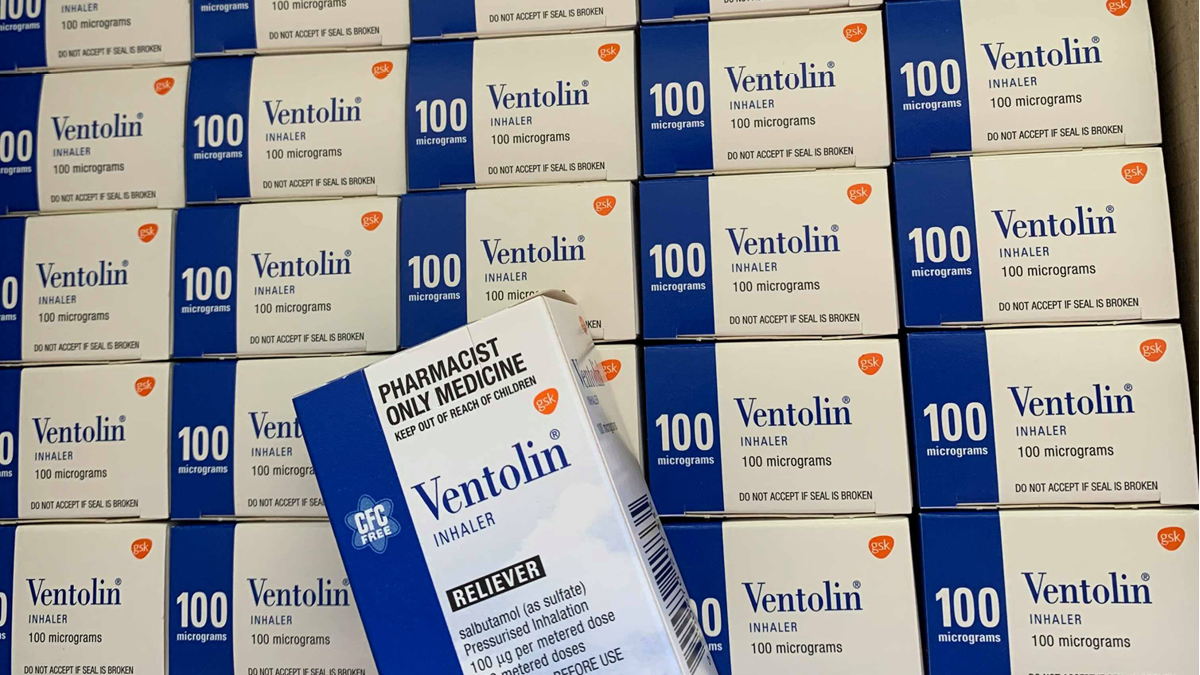
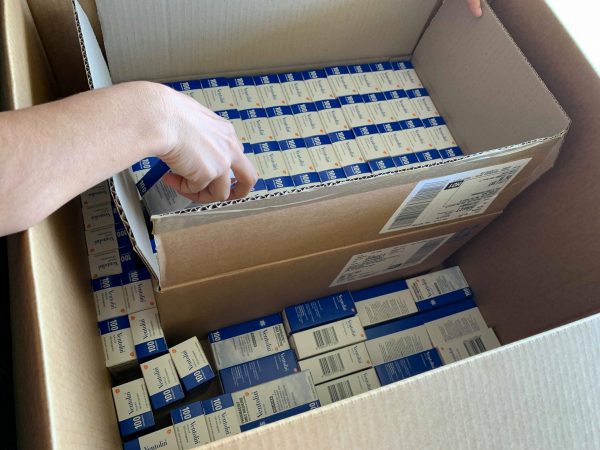
Glaxo Smith Kline (GSK) has generously partnered with AH&MRC and NSW Health, through the Centre for Aboriginal Health (CAH). They have donated 1,500 units of Ventolin (salbutamol) inhalers, as valued at over $7,500.

The AH&MRC will distribute these salbutamol inhalers to Member Services currently experiencing poor air quality due to bushfire smoke. These will be provided at no cost to patients experiencing respiratory symptoms, as clinically indicated.
Bushfire smoke can be an asthma trigger, even for patients who usually have mild symptoms. This may be a useful opportunity to remind people to review and update their Asthma Action Plan.

Air quality can be checked, for those areas with monitors, through the NSW Government’s website. In general, it is recommended for people to stay indoors and avoiding physical activity when air quality is hazardous. AH&MRC has worked with CAH to distribute P2 masks in bushfire smoke affected areas. Surgical or cloth masks unfortunately do not filter out the dangerous PM2.5 particles from bushfire smoke. A well-fitted P2 mask can help to reduce exposure to bushfire smoke, but needs a good seal to be effective. This video shows how to fit masks to reduce leaks.


The following resources may be useful for further information on the health impact of bushfire smoke and air quality.

Your Health Your Future at Battle of the Countries 2020

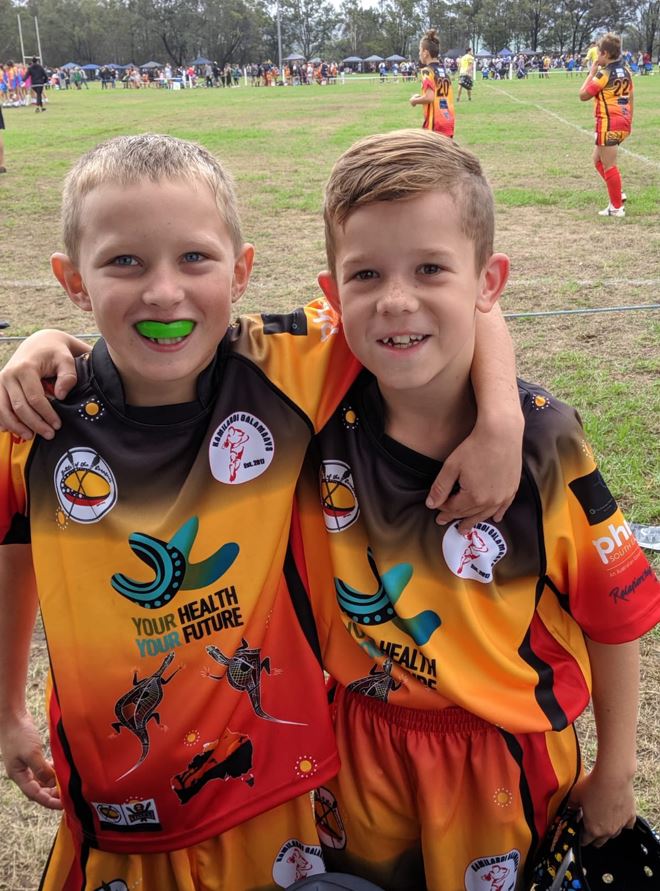
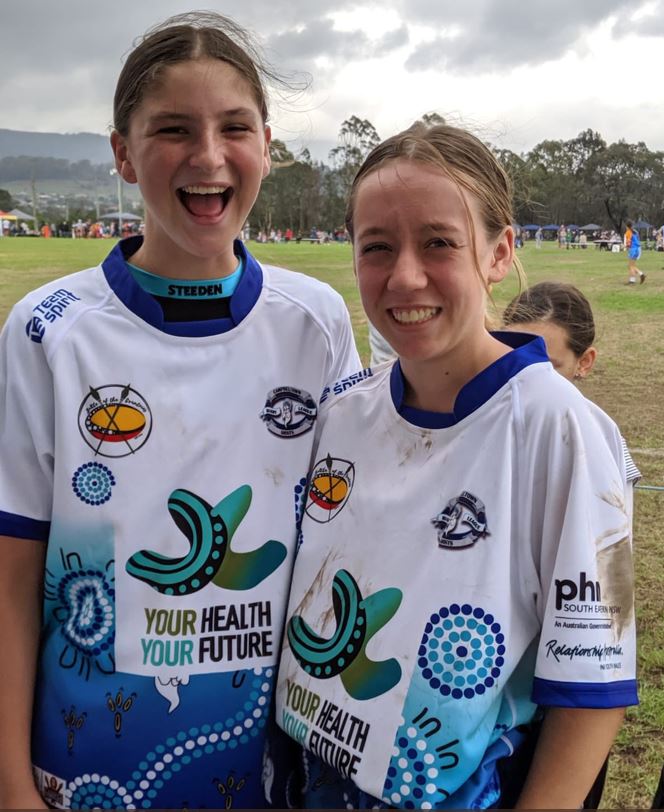
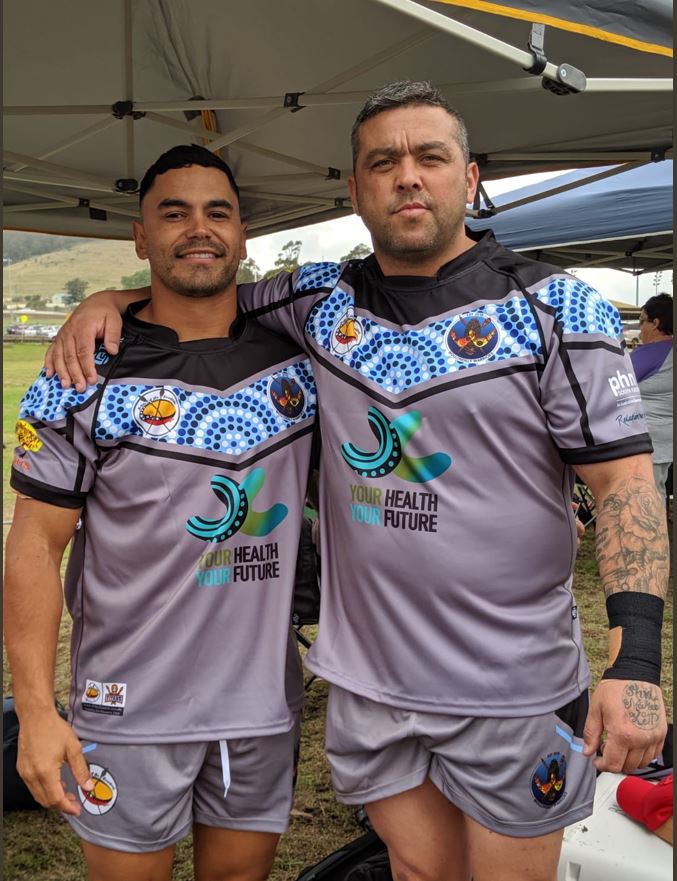
The Battle of the Countries made its inaugural debut in 2019 and the 2nd annual Battle of the Countries was held this year at Croom Regional Sporting Complex, NSW. The Illawarra Titans Rugby League Football Club was proud to host the 2nd Battle of the Countries event in 2020. Similarly to last year, the event was run over 2 days on the 18th and 19th of January 2020. Men, women and children living in Aboriginal communities across New South Wales, Victoria and Queensland were the target audience.  The event was a success, drawing in a large number of community members.

The purpose of the event was to bring together Indigenous communities, offering a first-class football knockout while raising awareness for suicide prevention and mental health in Aboriginal communities. Battle of the Countries and similar events help to create a space for services, young people and the wider Aboriginal and Torres Strait Islander communities from to enjoy football, engage in conversations and raise awareness of mental health issues that are often stigmatised and rarely discussed. The key messages were suicide prevention, mental health and wellbeing.

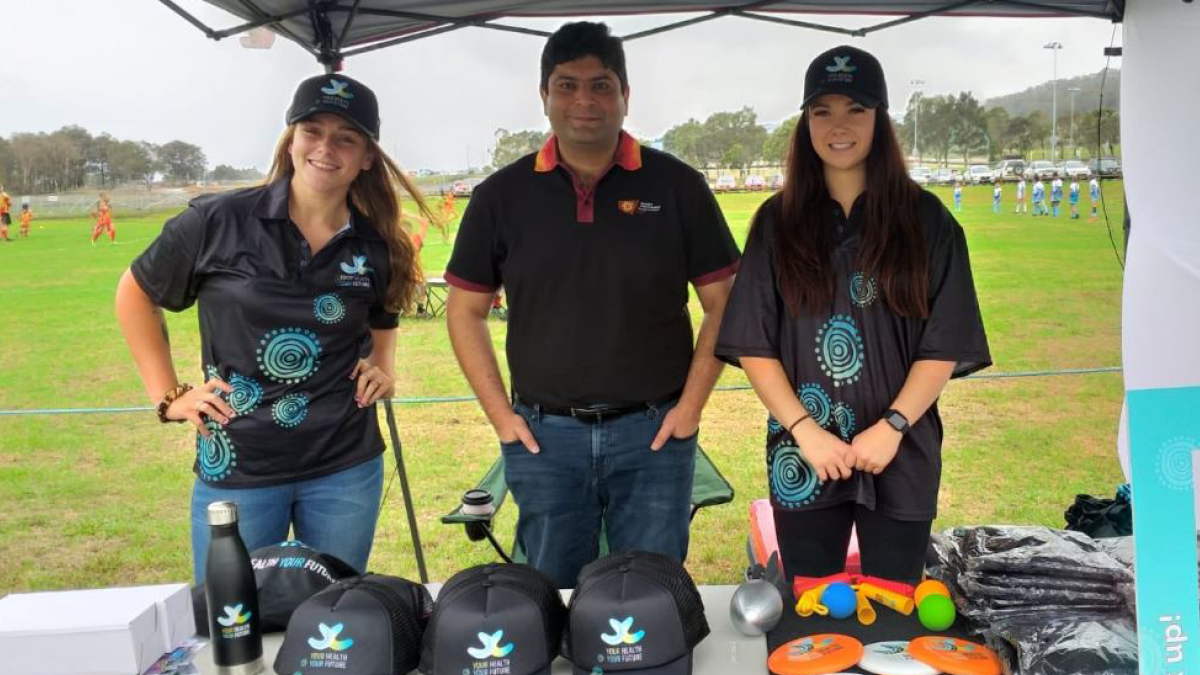
AH&MRC was one of the sponsors of Battle of the Countries this year. It was a great opportunity to promote the amazing work the team has done and continues to do in the health promotion space. The team shared Your Health Your Future merchandise including shirts, caps, bottles, frisbees and skipping ropes. It was an amazing opportunity for AH&MRC to learn, meet with community and network with other services and staff from other organisations.
Author:

Imran Mansoor, Public Health Team

Tharawal Art Therapy Program: Creating a Safe Place for Community Members to Heal

The Art Therapy Program was created by Tharawal Aboriginal Corporation in 2013 for the purpose of providing community members with a safe place to yarn. It is a non-clinical setting where vulnerable members of the community can open up about their struggles without feeling judged and discriminated against. The Program also creates a space for community members to express their feelings, using art as a medium. Through art, participants can explore the issues that have affected them in their life and begin viewing them from a different perspective to promote acceptance and healing.

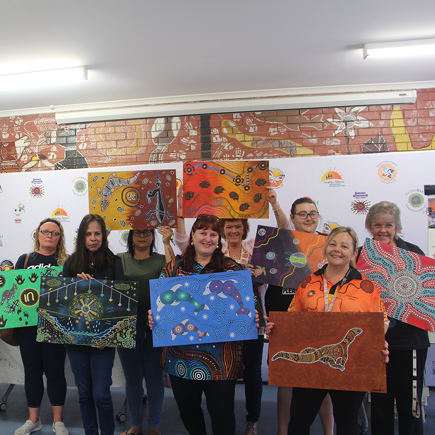
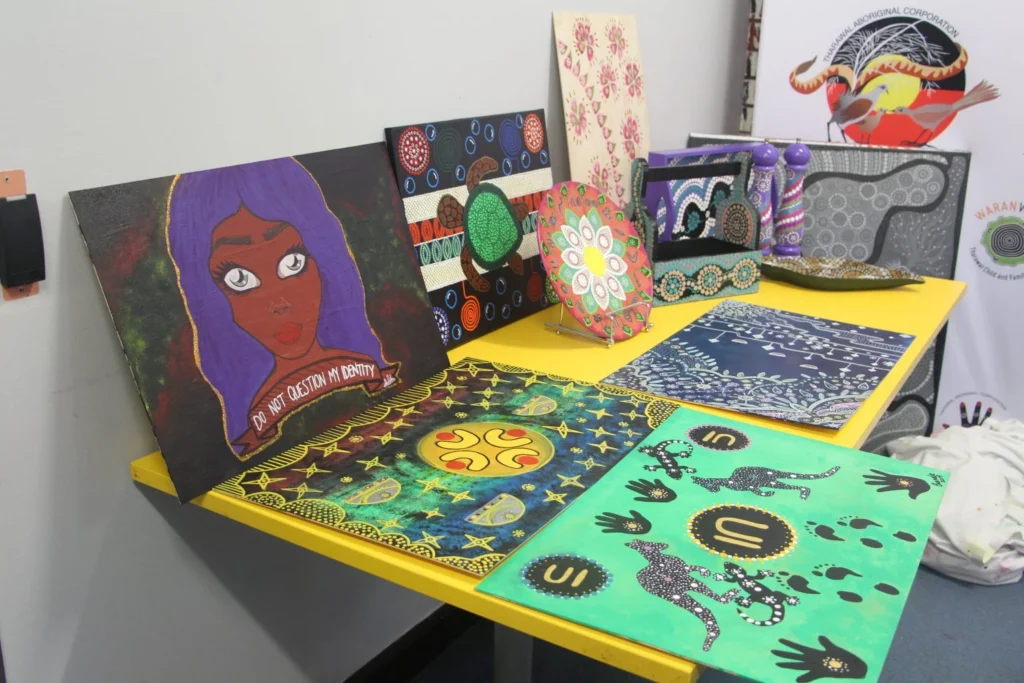
Artworks created by the Tharawal Art Therapy Class

‘We decided there was a need for some of the clients that suffer with mental health in the community. They would disengage with a lot of services, so we thought that we’d look at some ideas and see what they were interested in. We did try a couple of things, but we found that the art therapy really kicked off.’ – Dannielle Gillette, Mental Health Worker at Tharawal

A large component of Aboriginal peoples social and emotional wellbeing is feeling connected to culture and community. The Program covers both bases, incorporating traditional Aboriginal art and creating connections between community members who are part of the Program. For generations Aboriginal people have used art for storytelling and to chronicle knowledge of their land and mob.  The Tharawal Art Therapy Program teaches community members traditional art from their Nation, helping them to go back to their family roots.

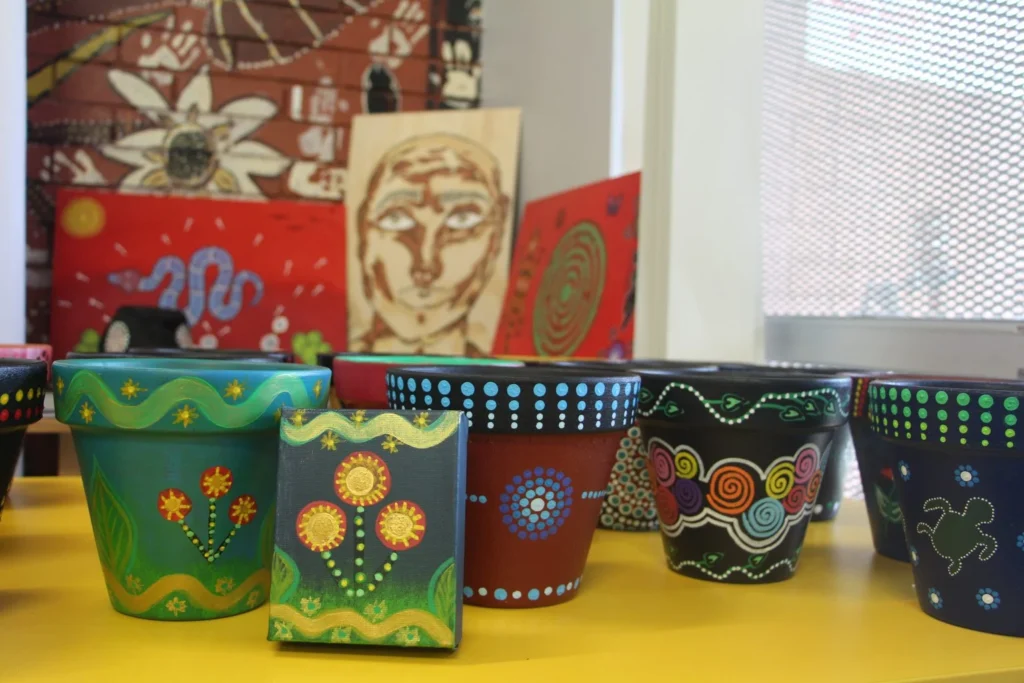
Flower pots and small canvas painted by the Tharawal Art Therapy Class

‘I feel more culturally connected. My mother is Anglo-white, we weren’t really cultural cause my dad was in an orphanage for stolen generations, so we didn’t know much. By coming here, I feel I’m connected. I’m able to connect with him even though we don’t know… Where his mum, where his dad is.’ – Joanne, Tharawal Art Therapy Program Class Member

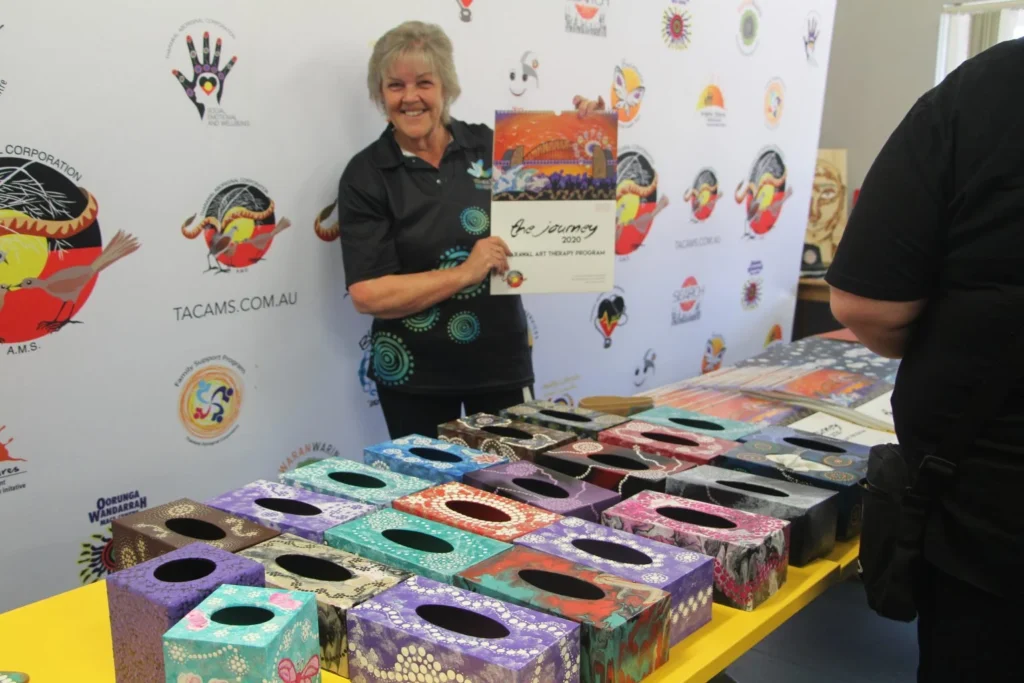
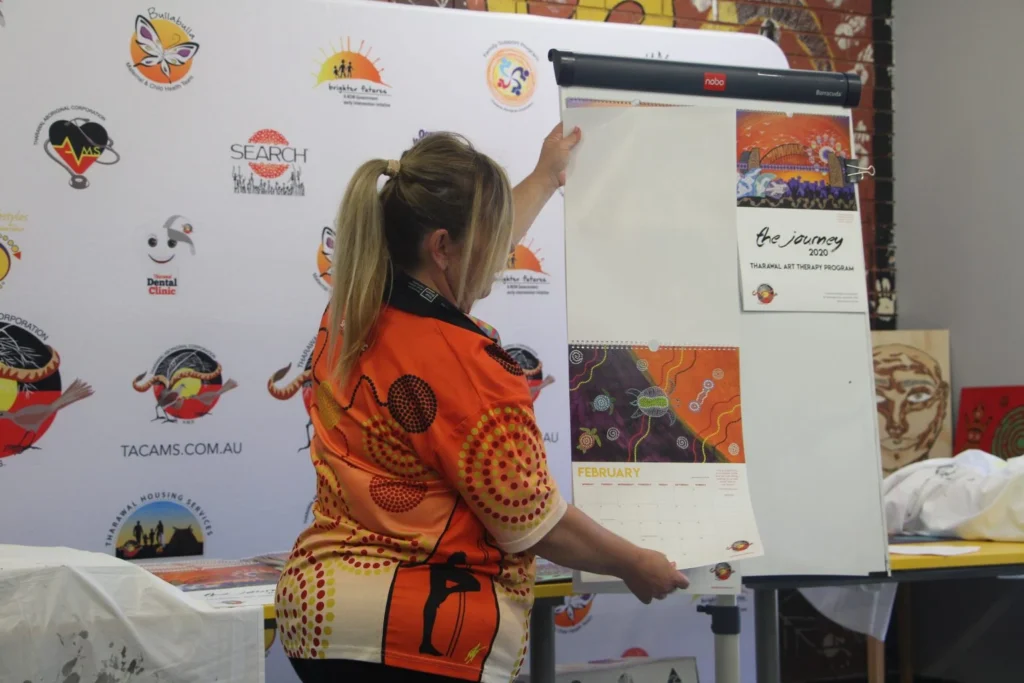
On Wednesday the 16th of October 2019, during Tharawal’s celebration of Mental Health Week, the Art Therapy Program presented The Journey 2020 Calendar, made up of artworks from 12 of the class members. The artists each used different symbols and totems originating from their local community to create beautiful artworks layered with meaning. The artworks were all uniquely different, using traditional styles and emotive colours to communicate the individual journey of each of the class members.

‘We made the Calendars with the group to show them what great artists they all are, and they should all be so proud.’ – Ondra Challinger, Tharawal Art Therapy Program Coordinator

The CEO of Tharawal, Darryl Wright and Program Coordinators Danielle Gillette and Ondra Challinger presented the artworks back to the artists. It was an emotional presentation, with artists sharing their struggles with mental health and how they had affected their life trajectories.

Mental health issues that deeply effect Aboriginal communities including domestic violence, suicide and drug and alcohol addiction were themes explored in the artworks. While usually these issues are approached with shame and stigma, many of the artists were proud of the struggles they had faced and overcome in their lives. Through owning their stories and connecting to culture and community, the class members have been able to grow and heal together.

Danielle presenting The Journey 2020 Calendar created by the Tharawal Art Therapy Class

Tharawal Aboriginal Corporation is selling The Journey 2020 calendars for $20 each. The funds raised from calendar sales will go towards purchasing resources for the Program. The Journey 2020 Calendars are a thoughtful Christmas gift option for family and friends. Don’t miss out!

Please contact Ondra (ondra.challinger@tacams.com.au) or Danielle (danielle.gillette@tacams.com.au) to learn more.

Author

Lucy Butler, AH&MRC Comms Team

Deadly Doctors Share Insights From The Sector

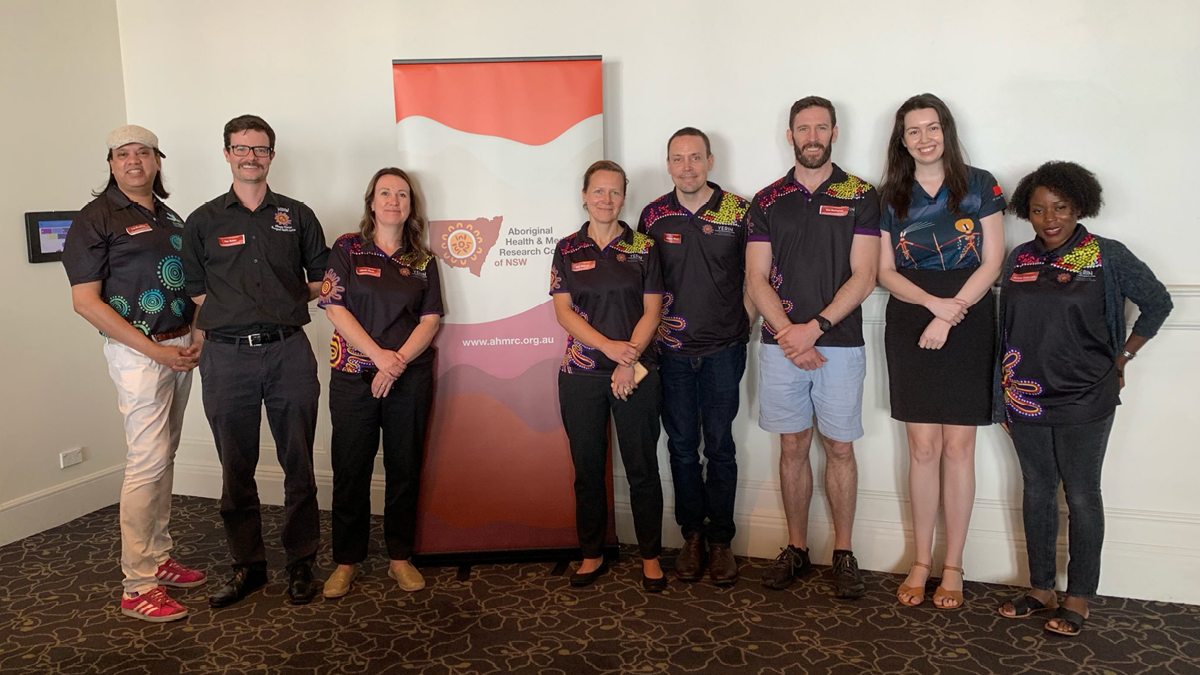
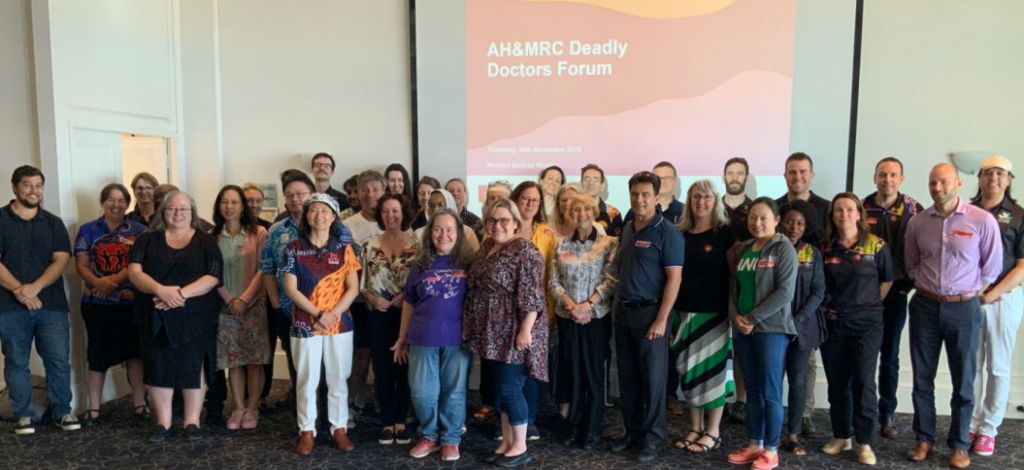
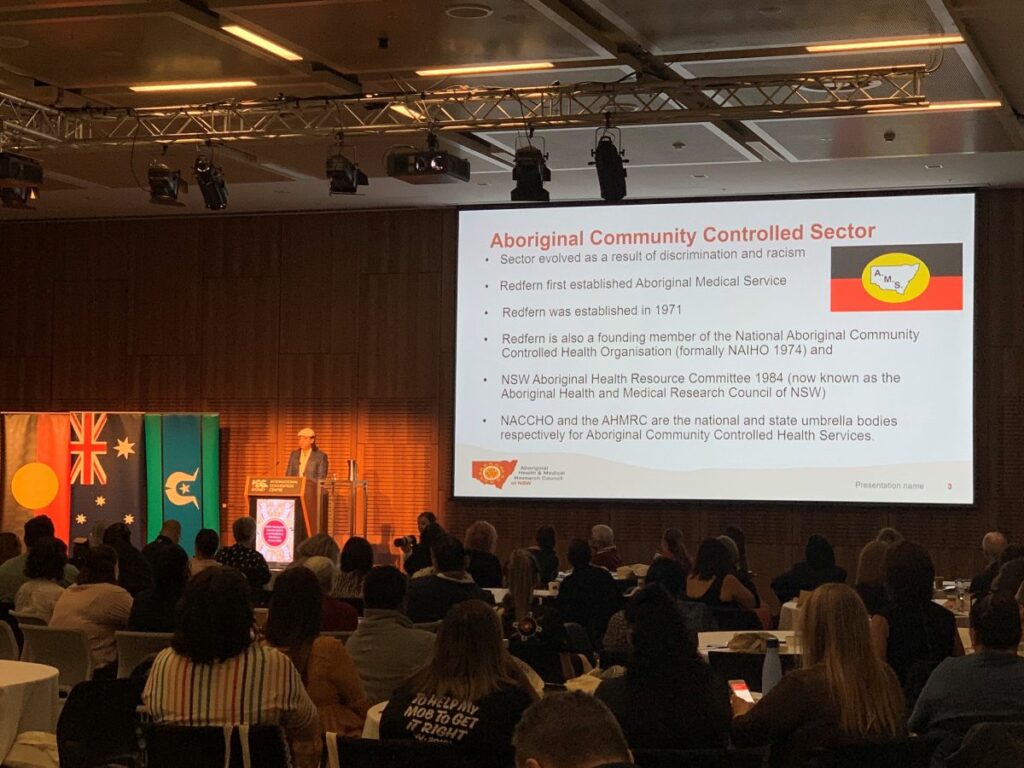
On the 28th of November 2019, the AH&MRC hosted the Deadly Doctors Forum as part of the Rural Doctors Network for our Member Services. A range of topics were presented by many wonderful speakers. The overarching objective of the Forum was to provide Aboriginal Community Controlled Health Services (ACCHSs) with a Forum to gain insight into what’s happening in the ACCHS sector and a chance to network with peers.
Member Services from throughout NSW gathered in Manly to hear about various topics in the health space from a range of speakers.
Kyla Wynn, Trish Levett and Dr Rowena Ivers discussed cancer and palliative care and how their team is assisting community members to attend appointments and grief counselling, as well as talking about some great initiatives from their Illawarra service.

Dr Clayton Spencer, Chief Medical Director of Western NSW Local Health District discussed the importance of accessing traditional healing practices from the Ngangkari Aboriginal healers and building career pathways using this scope of healing. Traditional approaches to healing are holistic taking into account the mind, body and spirit. In this sense, health is not just physical wellness but also connects kinship of the culture and community.
Dr Laila Tabassum provided an update on My Health Record, explaining the procedures behind providing better-connected care between patients and health organisations with the ability to upload clinical documents.

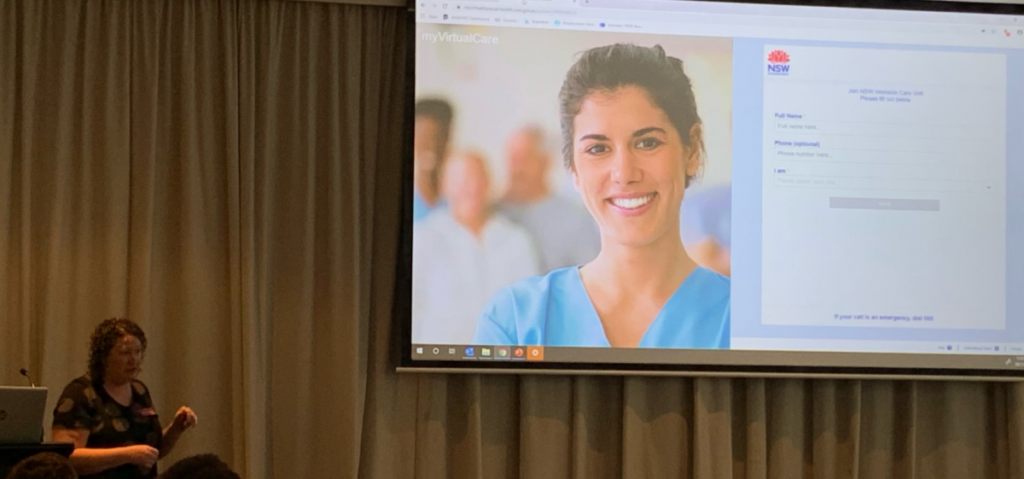
Donna Parks from the Agency of Clinical Innovation (ACI) spoke in detail about the use of Telehealth where clinically appropriate.

Ely Taylor from the Ministry of Health provided insights into the modification of the Influenza Season Preparedness toolkit, ensuring the document is culturally appropriate.

AMS Redfern’s Dr Kath Keenan discussed the effects, screening, diagnosis and treatment of Hepatitis C.

Dr Vlad Matic provided an informative presentation on Clinical Governance and the role of the GP, in which we discovered a continuing theme of W Edwards Deming quotes including the System of Profound Knowledge in relation to data collection and use.

Our Public Health Medical Officer (PHMO) Dr Kate Armstrong discussed the recently held PHMO meeting and introduced other PHMOs from around Australia.

Liz Moore from AMSANT in NT, Lucy Morris QAIHC in QLD and Sarah McLean VACCHO in VIC provided an update from their regions.

Nathan Taylor and Janeen Foffani presented on the Program of Experience in the Palliative Approach (PEPA), where they discussed their approach to education and training of the health workforce and delivery of programs to primary, secondary and tertiary health care provider groups.

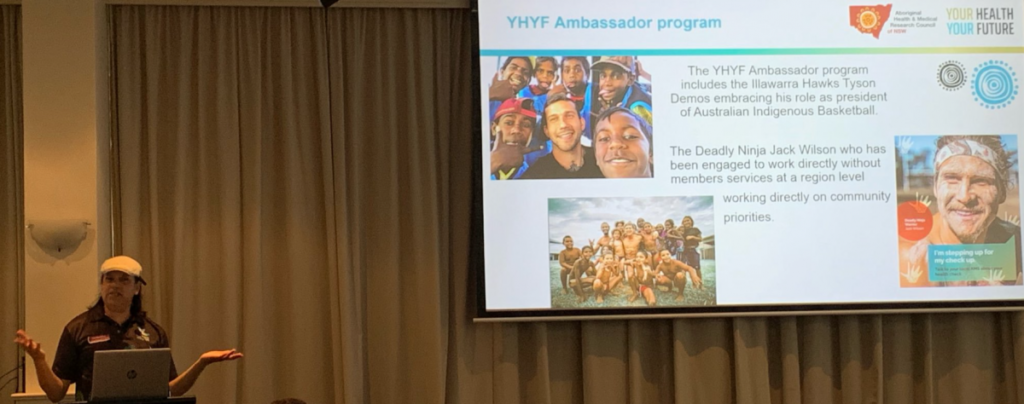
The Your Health Your Future (YHYF) campaign was discussed by our Public Health Manager Lee Bradfield who spoke about member collaboration, the Ambassador program with the Deadly Ninja Jack Wilson, and Illawarra Hawks Tyson Demos, plus funding plans for 2020 and available resources.

Information regarding Chronic Obstructive Pulmonary Disease (COPD) and Pulmonary Rehabilitation was provided by Dr Jennifer Alison and David Meharg. Details on guidelines, GP action plans and upskilling on medication use were discussed in detail.

Dr Karin Jodlowski-Tan from the Remote Vocational Training Scheme (RVTS) highlighted the model of training their organisation provides. Susan Anderson presented on the NSW Aboriginal Cancer Scoping Project, with statistics to be released in 2020.

Overall the day was highly informative, and we look forward to future Deadly Doctor Forums.

For more information about future Deadly Doctors Forums, please don’t hesitate to contact AH&MRC Public Health Officer Imran Mansoor IMansoor@ahmrc.org.au

Author – Zoe Mead, AH&MRC Public Health Team

Highlights from the Aboriginal Mental Health and Wellbeing Forum

On the 27th and 28th of November, AH&MRC co-hosted the NSW Aboriginal Mental and Wellbeing Workforce Forum in partnership with the Justice Health and Forensic Mental Health Network. The Forum brought together Aboriginal Mental Health and Wellbeing Workers working in various sectors to build knowledge, create partnerships and improve mental health service delivery for Aboriginal people.  The Forum was open to Aboriginal people and non-Aboriginal people whose work significantly involves Aboriginal consumers, or who work in other roles significantly contributes to Aboriginal mental health and wellbeing; such as in management, research and policy-related fields.

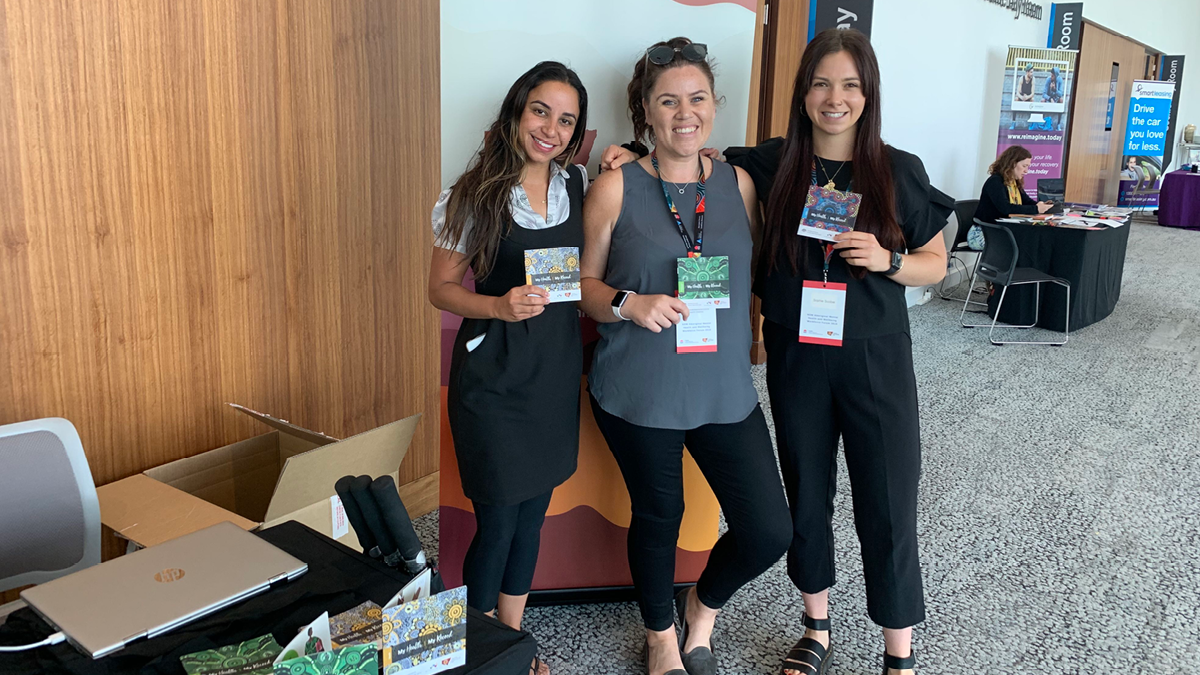
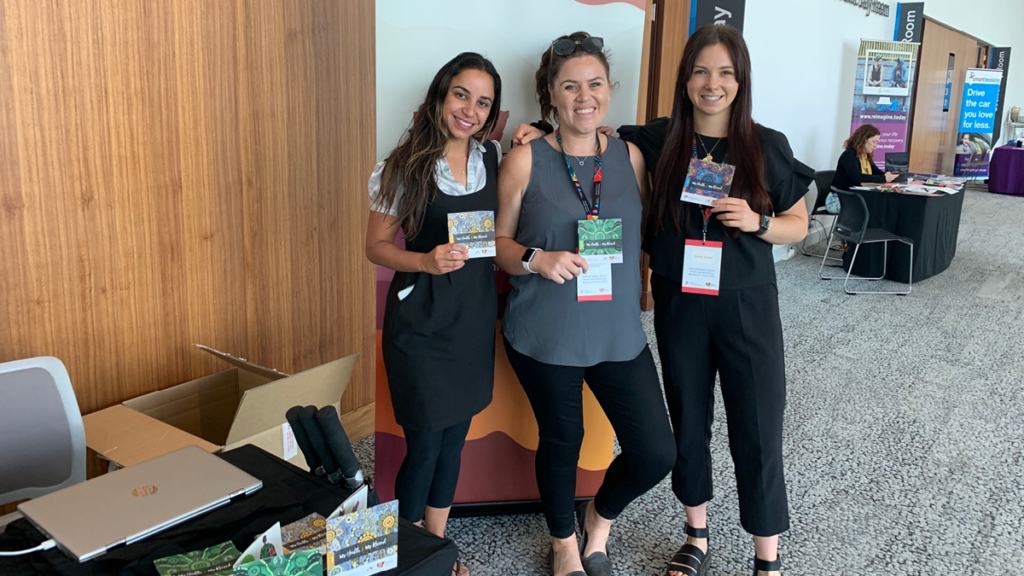
AH&MRC had an exhibit at the event to promote the amazing work the team has been and continues to do and shared resources such as Your Health Your Future merchandise, My Health Record information books, Self Care Toolkits, Strength Cards and Health Journals. AH&MRC also supported 20 staff from our Member Services to attend and provided compensation for travel and accommodation. The Forum was an amazing opportunity for staff to learn what work and support is being offered in the sector and network with other services and staff from Government and Non-Government Organisations.
The two days were jam-packed with presentations from industry leaders and truly inspirational individuals who are not only changing the industry but also setting the example for the next generation to have a voice and ensure the health system is supporting Aboriginal and Torres Strait Islander people to live a healthy and happy life.

Presentations ranged from traditional healing, to how we can better protect and record Aboriginal and Torres Strait Islander health data and research. Stand out presentations included;

Our very own Public Health Manager Lee Bradfield who was the first Keynote Address on the first day discussed the role AH&MRC plays is supporting “Journey’s in Aboriginal Mental Health and Wellbeing”. Lee reflected on the amazing work that the AH&MRC has accomplished in the past 12 months and what projects, events and advocacy are proposed for the future.

Other amazing presentations from the first day included; Stephen Cochrane, Manager of Aboriginal Stakeholder Engagement, SafeWork NSW and Aboriginal Programs and Andrew Rowe, Principal Inspector, Psychosocial Services, SafeWork NSW “Aboriginal Mental Health Initiative – SafeWork NSW”, discussing the issue of workplace bullying and what services and support are available for Aboriginal staff.

Donna Murray, Chief Executive Officer from Indigenous Allied Health Australia (IAHA) discussed, “Pathways: Creating a sustainable future for Aboriginal mental health and wellbeing workforce” and the role IAHA plays in support Aboriginal people working within the health sector. For more information about IAHA check out their website https://iaha.com.au/

Despite the heavy topics covered, the first day ended on a light-hearted note with the help of Dane Simpson’s comedy performance and Koorioke with Uncle TJ Simpson.

The second day started with an amazing Keynote Address from Dr Francesca Panzironi, CEO of Aṉangu Ngangkaṟi Tjutaku Aboriginal Corporation (ANTAC). ANTAC is the first organisation of Aboriginal traditional healers in Australia. Dr Panzironi spent four years (2008-2012) travelling across South Australia in search for answers to the lack of recognition of Aboriginal traditional medicine in international and national health policy frameworks and strategies. For more information check out the ANTAC website https://www.antac.org.au/about-antac/about-us

Jude Page PhD Candidate from the Centre for Primary Health Care and Equity, UNSW Sydney held a thought-provoking presentation on “Visual Communication tools (My Story Cards): a client-centred approach to communication, reflection and shared understanding.” Story Cards are a new image-based therapeutic tool. The use of visual images has been proven to provide a more powerful link to emotions than words alone. The Story Cards are a quick, efficient means of identifying issues, exploring issues and facilitating goal setting. For more information check out the My Story Cards website.

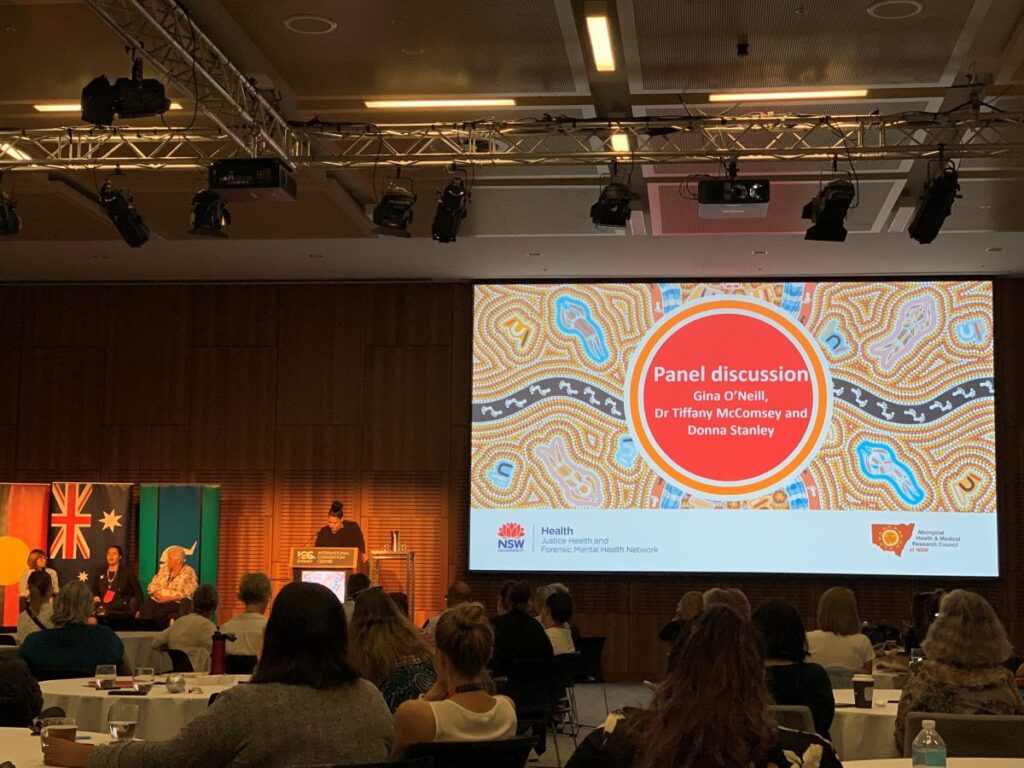
The next session was a panel of deadly women including our very own Trainer and Educator Gina O’Neill, alongside Tiffany McComsey, CEO of Kinchela Boys Aboriginal Corporation, and Donna Stanley, District Coordinator in Aboriginal Mental Health and Drug & Alcohol at the Western NSW Local Health District. All women provided a unique perspective, discussing the different experiences of Aboriginal people’s journeys in mental health and wellbeing, the challenges that Aboriginal people face and how these can be mitigated. All women are strong, passionate advocates for the sector, and it was such a privilege to be able to hear their stories and benefit from their experiences and knowledge.

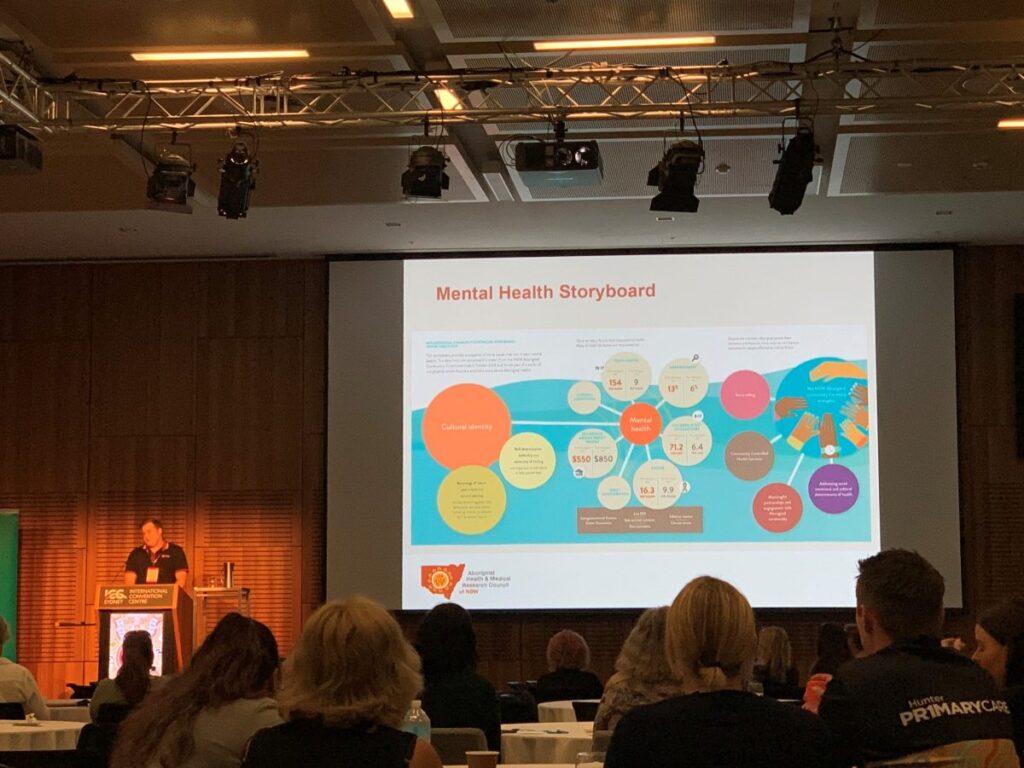
To finish off what was an incredible, inspirational and informative 2 days, our very own Data and Systems Manager Dean Wright presented on, “Using Data to Tell Stories and Track Pathways to Aboriginal Health and Wellbeing in NSW”. Dean had the difficult task of encouraging a worn-out crowd to get excited about data at 3pm on a Thursday. However, for the most part he succeeded and using the Mental Health Storyboard and inclusion of infographics and visual representation, inspired even some of the least data inclined. The Health Tracker is a project that AH&MRC has been working on for some time and will be using to share health information in an engaging and easy to understand way while also protecting the data governance of Aboriginal people.

Overall the 2 days were extremely informative and left AH&MRC staff who attended inspired full of ideas, having developed relationships with key stakeholders, organisations and researchers. We look forward to working together collaboratively to improve the journeys in Aboriginal Mental Health & Wellbeing.

Author – Sophie Scobie, AH&MRC Practice Support Team

Oceania Conference – Making Tobacco Control a Priority

This year, the Oceania Tobacco Control Conference was hosted on Gadigal land in Sydney on the 22-24 October 2019. Held biennially, the Conference provided a unique opportunity for a ‘meeting of minds’, bringing together Tobacco Control Researchers, Advocates, Policy Makers and Program Administrators from Australia, New Zealand and Pacific Island Nations.

The 2019 theme was ‘Making Tobacco Control a Priority’ and reflecting this drive for a renewed focus on the topic, the unofficial motto of the conference was ‘smoking is still the new smoking’, meaning that while other ‘new’ health problems might get more attention, smoking is still the leading cause of preventable disease in Australia”.

AH&MRC and the Cancer Council NSW provided 14 team members from ACCHSs with scholarships to attend the conference. This included staff from Galambila, Illawarra, Griffith, Bullinah, Redfern, Albury Wodonga, RivMed, Yerin, Griffith, Tobwabba and Waminda.

AH&MRC was this year’s Aboriginal Health Partner for the conference. AH&MRC contributed to an array of cultural elements throughout the Conference program including hosting the Gamarada Yarning Circles. Gamarada is a local Sydney word for friend and comrade. Lee Bradfield, Public Health Manager represented AH&MRC on a panel asking, “What has happened since the Statement by Indigenous people to the 2017 Oceania Tobacco Control Conference?’, including the research, policies and community controlled cessation programs to reduce smoking.

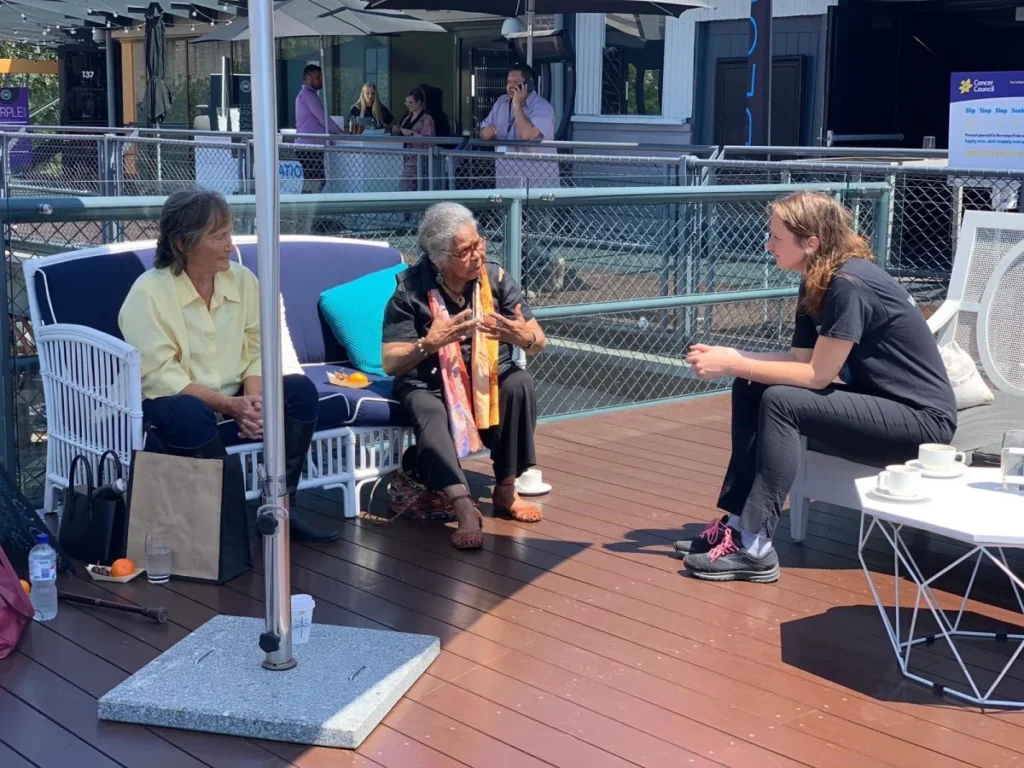
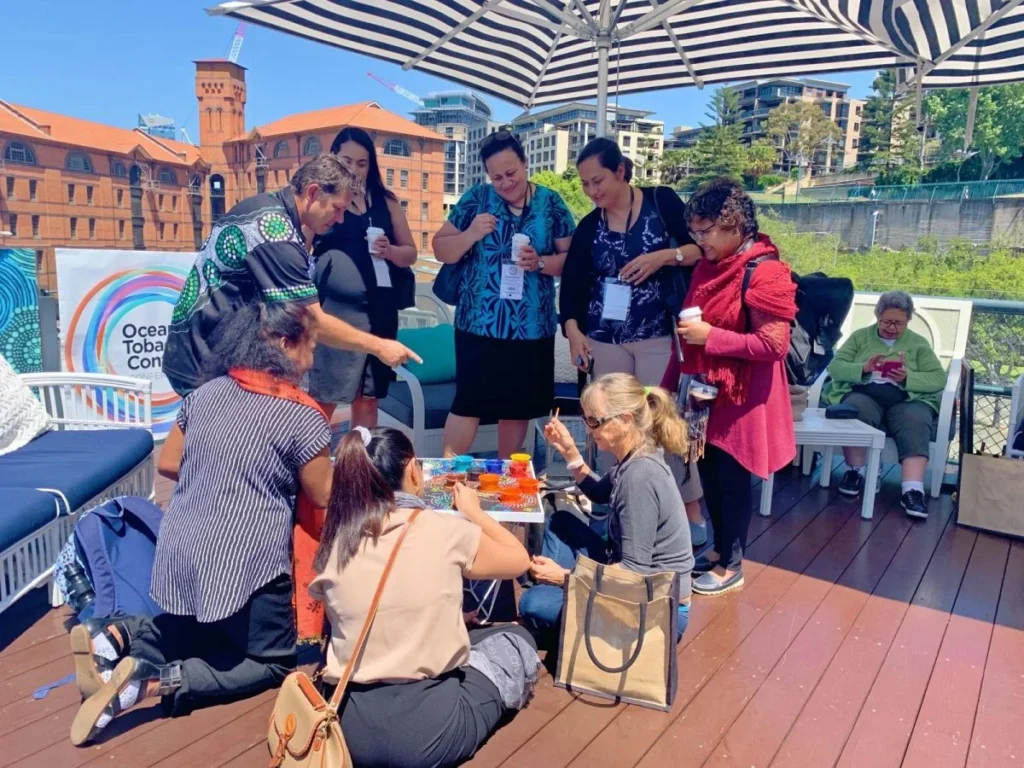
At the Gamarada Yarning Circles, conference participants met our local Aunties – Ali, Ann, Annette, Barb and Stephanie. Through the yarning circle with the Aunties, we learned and shared experiences of spiritual and cultural safety.

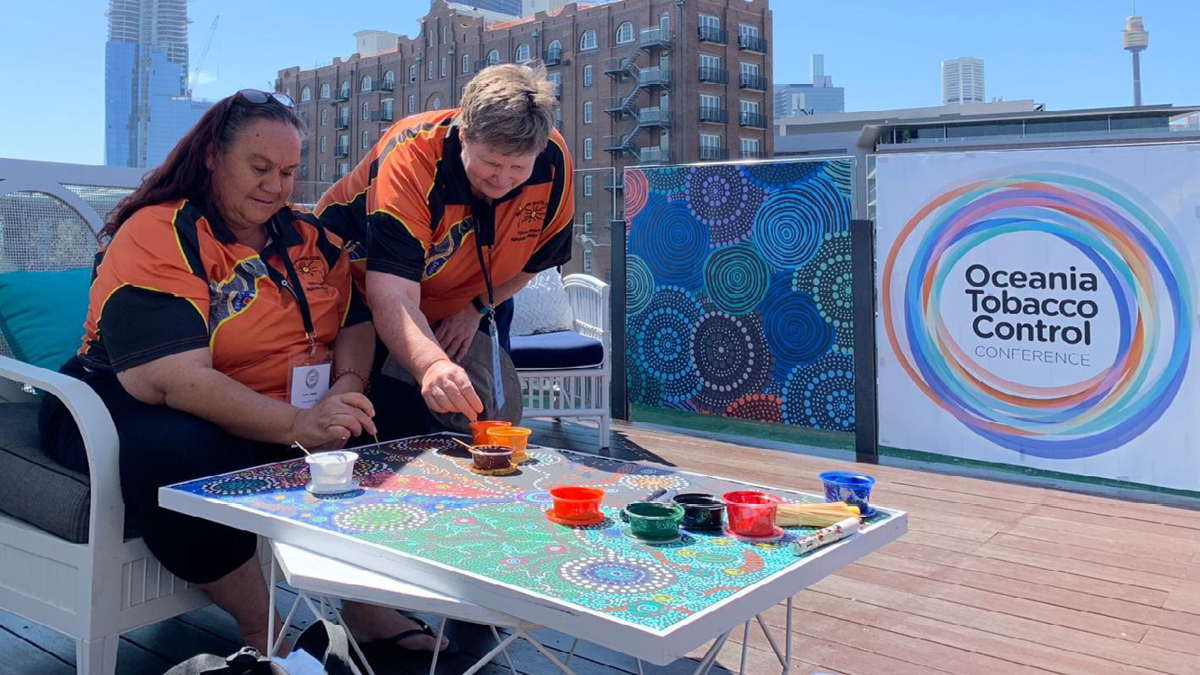
As part of the Gamarada Yarning Circles conference participants helped to develop a communal painting guided by Trevor Eastwood and Jason Douglas, Indigenous artists from Dalmarri.

There was a strong focus on Indigenous strategies to tackle smoking, and a highlight was Galambila’s powerful video on Tacking Indigenous Smoking presented by Connie Smith, which advocated for tobacco control from the perspective of children. Further afield in the Pacific, a New Zealand community was working on creating smoke-free spaces, which resulted in the local Maori community banning smoking at kids’ footy and in the car. Legislation was passed in Kiribati to prevent tobacco sales near schools. Speakers at the Conference also explored that for many communities, smoking is a result of colonisation and intergenerational stress and trauma and in some cases, tobacco was used as a form of ‘payment’ to Aboriginal people.

Passionate speakers from all over Oceania also shared their own projects and research relating to tobacco control, ranging from innovations in plain packaging, sales and retail restrictions, and the concept of the mythical “third rail” (the end of tobacco sales). Stronger support for tobacco control in hospital settings was raised, with the analogy to healthcare professionals being:

“If your patient had open wounds on their leg you wouldn’t ignore it, so why ignore smoking as a risk factor?”

A copy of the conference program which includes a strong focus on the experience of First Nations peoples is now available online.

Author – Nina Betts, AH&MRC Public Health Team

Katungul’s Wellbeing Centre – Healthy mind, body, spirit

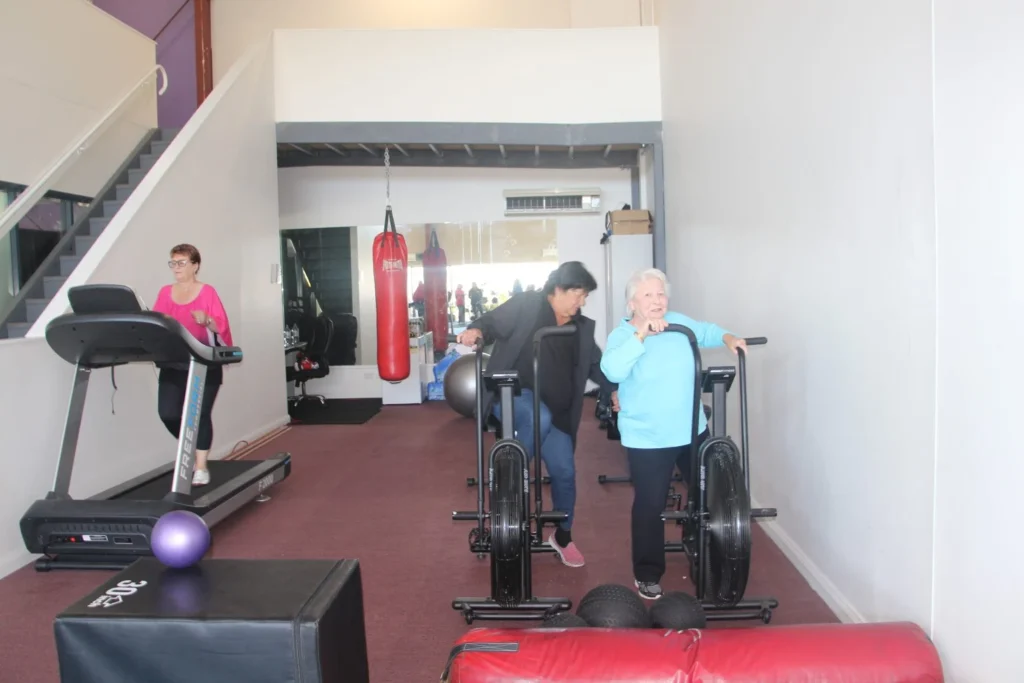
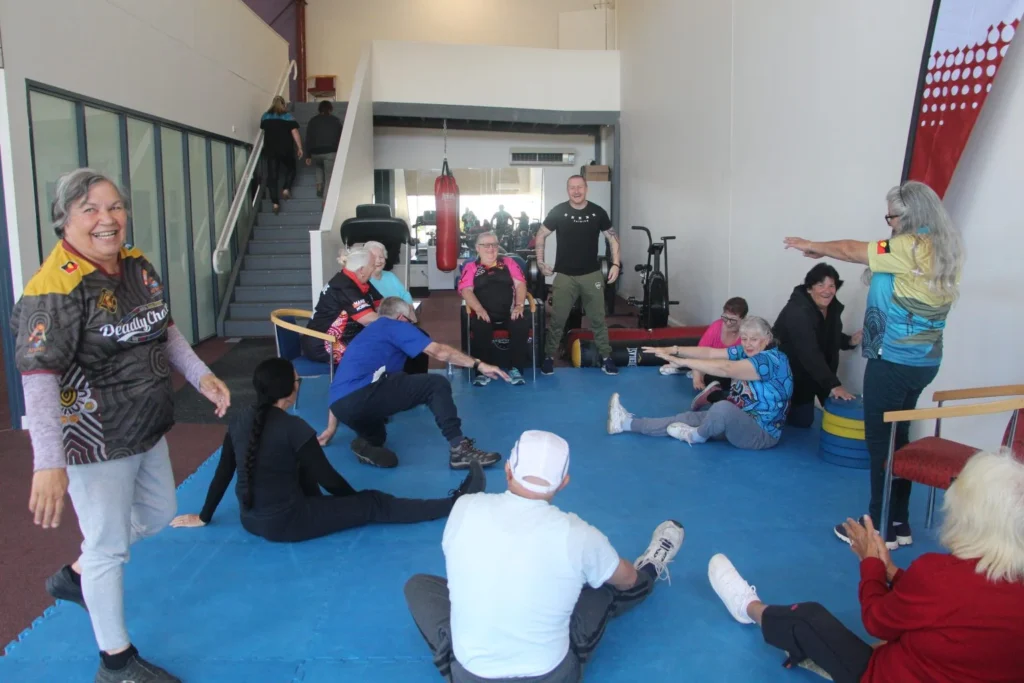
On the 24th of September AH&MRC visited Katungul’s Bateman’s Bay Service to see their Social Wellbeing Centre in action. The Wellbeing Centre focuses on community-orientated programs which support Aboriginal people with or at risk of chronic illness, mental health, addiction and social isolation. The Centre recognises that community members have varying levels of physical fitness and encourage people to get active in whatever way they can.

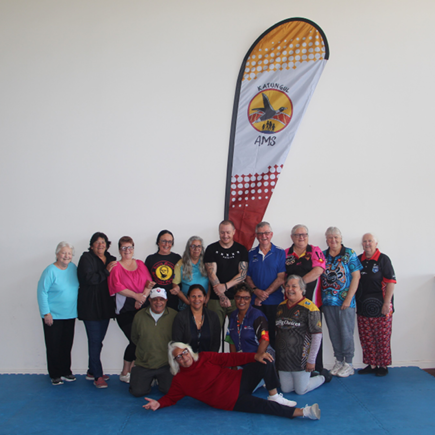
Community members warm-up before the exercise group begins

While group members had their screenings done by a Medical Practitioner, AH&MRC were able to chat to one of the Centre’s Personal Trainers, Joe White. Joe mentioned that while the Wellbeing Centre’s Programs are designed for people to get active, it’s more about people having fun and finding a sense of community connection. Laughter is encouraged as one of the best forms of medicine.

Katungul’s Wellbeing Centre is holistic, focusing on social and emotional wellbeing as well as physical exercise. While chatting to group members it became clear that the main reason people keep coming back is because of the sense of community and connection the programs offers, exercise is an added benefit.

The group do some stretching and have a laugh while they go about it

The session started with people hopping onto the exercise mats. Before the exercise kicked off, everyone paid respects to the Stepsister of one of the members who had recently passed away. Cultural safety is recognised throughout all of the Centre’s programs which encourage community members to share stories, history, family connections and, at times, their grief as well. A minute of silence passed and Joe instructed everyone to start stretching. The mood began to lift, and silence was quickly replaced by laughter and chatter.

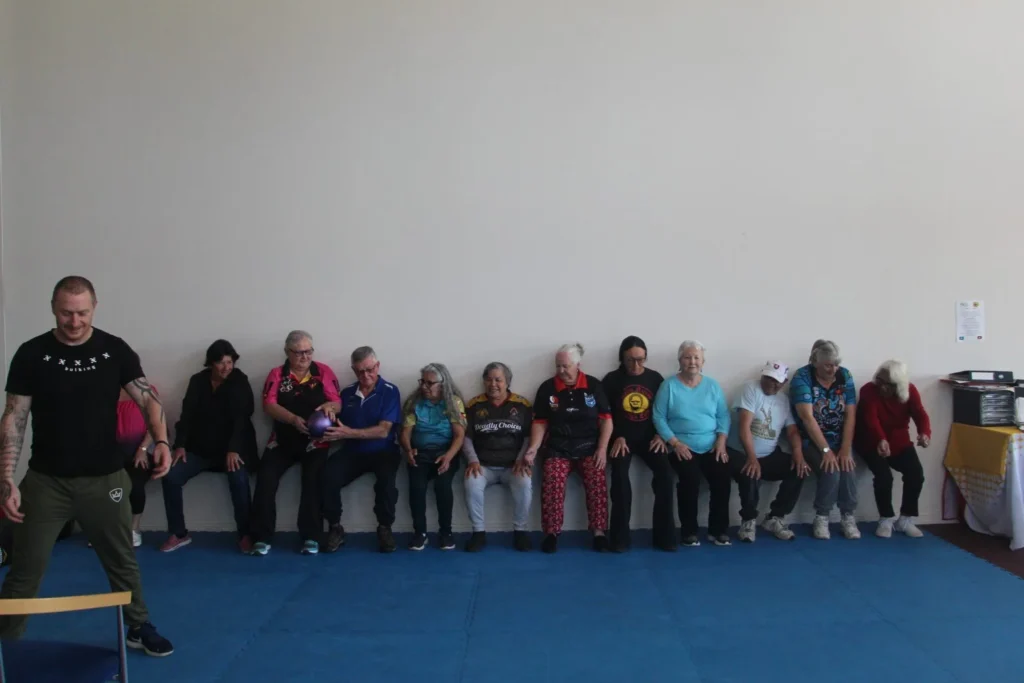
The session heats up with group members instructed to squat against a wall and pass a ball back and forth

Things quickly amped up when Joe instructed everyone to squat against a wall in a line and pass an exercise ball back and forth. At this point it became clear who was new to the group and who was a regular – a few people couldn’t handle the heat.

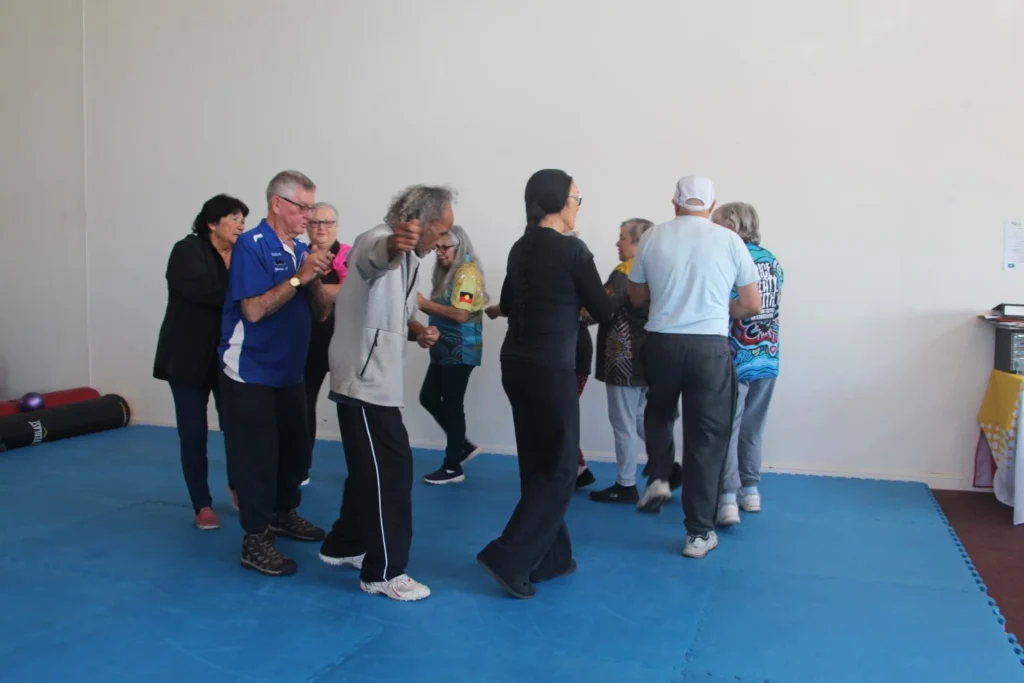
The exercise regime concluded and it was time for the group to discuss the Mini Olympics, with an opportunity to rehearse their nominated dance. For information on the Aunty Jean’s Mini Koori Olympics please click here.

The group rehearse their dance for the Mini Koori Olympics

Most of the Wellbeing Centres programs finish up with lunch provided by the Service. On our visit, the lunch was a healthy spread of wraps, chicken, salad, rice crackers and avocados. Everyone involved – community members, program organisers and AH&MRC alike – gathered in Katungul’s conference room next to the gym and had a yarn over lunch. In closing, it became clear that Katungul’s Wellbeing Centre Programs offer more than just an exercise regime, but instead the opportunity to be part of a community of friends brought together by the common goal of getting healthy.

AH&MRC would like to thank Katungul Staff, Southern NSW Local Health District, Katungul’s Personal Trainer Joe White and all the participants on the day for welcoming us into the Service and allowing us to take photos for the 2020 Members Calendar.

Author – AH&MRC Communications Team

Representing Your Health Your Future at the Aunty Jeans Koori Mini Olympics

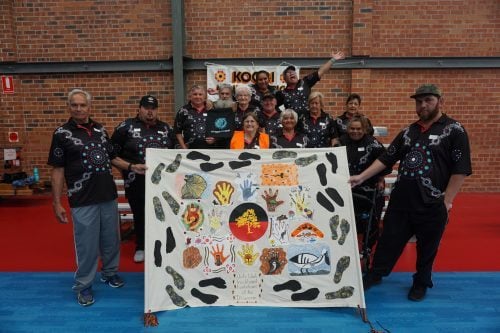
The Aunty Jeans Program was originally founded by the Illawarra Shoalhaven Local Health District, Aboriginal Chronic Care Unit, in memory of a well-respected local elder who was passionate about Aboriginal health, advocacy and culture.

The Aunty Jeans Program is a community orientated program to support Aboriginal people with/or at risk of chronic illness. The Program combines health promotion and health assessments, information and education, exercise sessions, healthy eating and fun activities.

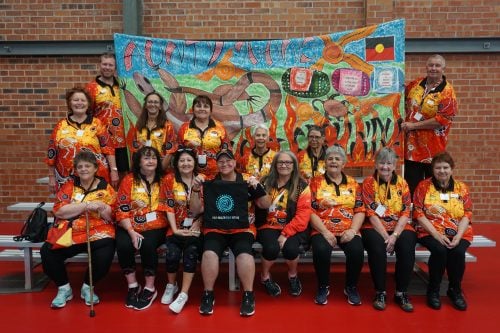
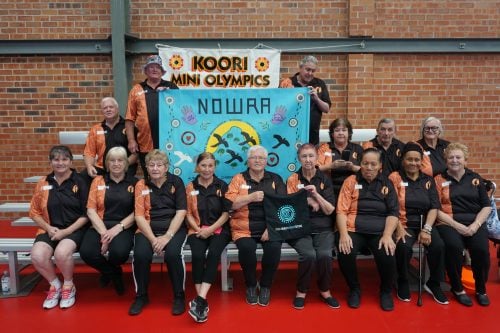
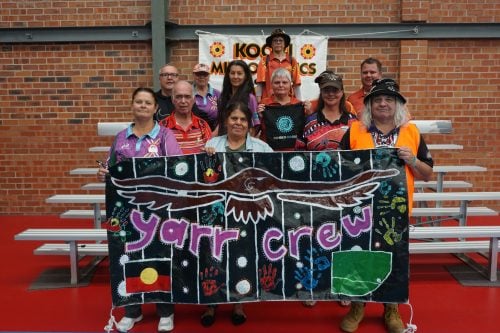
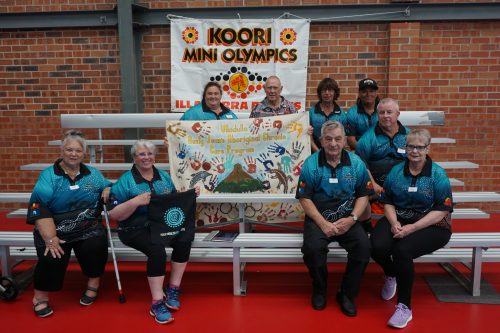
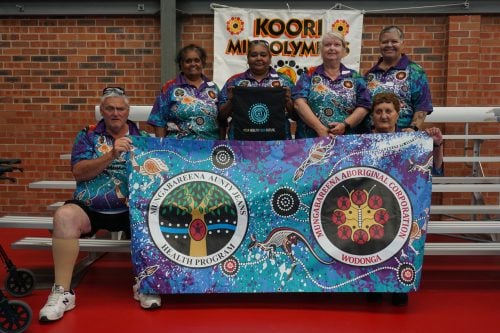
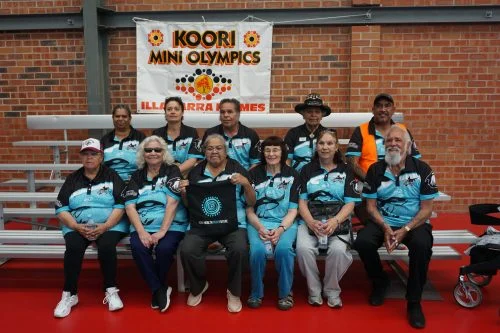
Above from left (Illawarra) to right (Mungab) 

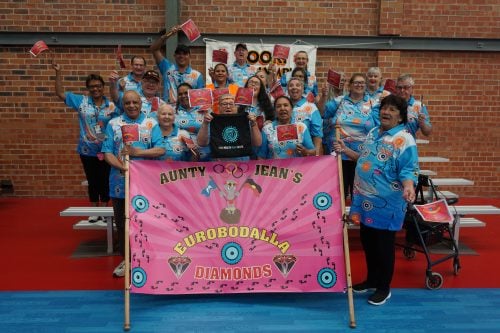
Above from left (Eden) to right (Eurobodalla)

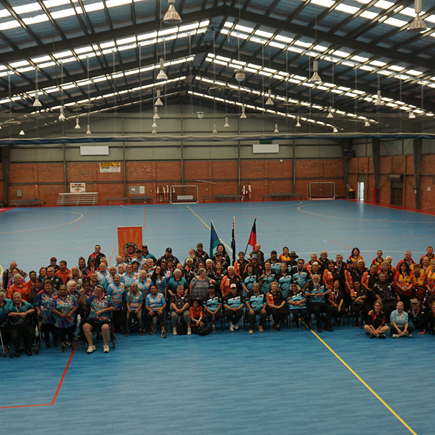
The Aunty Jeans Program has spread far and wide across NSW. Every year the Program organisers bring together teams to compete in the Aunty Jeans Koori Olympics. This year teams from all around NSW faced off in games such as Kee’an (an Aboriginal throwing game traditionally using an animal bone), quoits, bullseye, frisbee, javelin and ten pin bowling.

In 2019 Aunty Jeans Koori Mini Olympics celebrated its 15th birthday and to mark the occasion organisers brought the event back to home soil. The event had an estimated attendance of 150 participants.

Above from left (NC Winnera) to right (Nowra)

Above from left (Yass Yar Crew) to right (Ulladulla)

Unfortunately, AH&MRC were not able to attend the Aunty Jeans Koori Mini Olympics that took place on Wednesday 23rd of October 2019, but we were there in spirit and are so glad that we were able to provide the participants with Your Health Your Future merchandise.

AH&MRC would like to extend our congratulations to the Coordinators of the event – ‘The Aboriginal Chronic Care Unit’, the participating teams; Illawarra flame tree, Eurobodalla diamonds, Yass Yarr crew, Mungabareena (Wodonga) Aunty Jeans, Eden Aunty Jeans, Ulladulla Aunty Jeans, Nowra Aunty Jeans and of course the 2019 winning team – Central Coast Aunty Jeans.


Authors – AH&MRC Public Health Team