



Our People to Live Stronger & Longer

Don’t Miss Out – Aboriginal Cancer Care Coordinator Grant

Applications are still open for the Aboriginal Cancer Care Coordinator (ACCC) Grant under the Aboriginal Cancer Primary Care Pathways Program. This grant supports Aboriginal Community-Controlled Health Organisations (ACCHOs) across NSW to employ a dedicated Aboriginal Cancer Care Coordinator for a three-year period. 

These new roles will help: 

  • Strengthen culturally safe, community-led cancer care 
  • Improve access to cancer screening and treatment 
  • Support timely referrals and coordination with cancer services 
  • Promote health literacy and reduce barriers to care 

About the Grant: 

Funding available: Up to $383,600 (excl GST) per service over three years 

Number of positions funded: 15 across NSW

Application period: Open now until 6 June

 We encourage your service to consider applying. The Grant Guidelines can be found here and the Application Form here

If you have any questions or need support with your application, please contact:
Sushira Sharma, AH&MRC Project Officerssharma@ahmrc.org.au 


AH&MRC at the Preventive Health Conference 2025: “Prevention is Political”

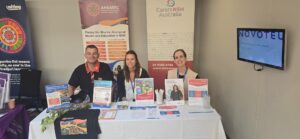
From 28–30 April, AH&MRC staff joined public health leaders, researchers, and advocates at the Public Health Association of Australia’s Preventive Health Conference in Canberra. This year’s theme, “Prevention is Political”, sparked powerful discussions on how political systems, commercial interests, and social structures shape health outcomes—and how we must advocate for policies that prioritise prevention and equity. 

Key Takeaways for Our Work: 

  • Food Security: Presentations from Victoria highlighted innovative models like social supermarkets and food mapping. These insights build on AH&MRC’s knowledge which will help us develop strategies to strengthen food security initiatives in NSW. If your service has successful strategies, we want to hear from you! 
  • Cancer Prevention: Sessions featuring Cancer Institute NSW, Cancer Council Victoria, Aboriginal Medical Services, and research institutions showcased co-designed campaigns and culturally adapted screening tools. These initiatives are improving early detection of cancer in Aboriginal communities. The need for sustained funding and Aboriginal workforce development was clear – we hope that the AH&MRC grant opportunity for our members to have 3-years of funding for a cancer coordinator position will be a start to addressing this need. 
  • Tobacco & Vaping: “Kilung Morunbul Jum” (‘Death by Smoke’ in Yugambeh language) was the statement sculpture in the conference lobby, commanding a powerful presence for the conference. This art piece highlighted how tobacco use within Indigenous communities has had a significant contribution (37%) to Indigenous Australian deaths. From this powerful art installation to youth-focused cessation strategies such as phone apps, the message was strong: we need culturally relevant, community-wide approaches to reduce tobacco and vaping harms. 

Call to Action: AH&MRC is committed to integrating these insights into our ongoing work to support and strengthen Aboriginal Community Controlled Health Services across NSW. We want to encourage the sharing of knowledge across our NSW network. If your service is working on food security, cancer prevention, or tobacco control, we’d love to showcase your efforts and give others the opportunity to learn from your success. Let’s continue building a healthier, more equitable future—together. 

Got ideas or work to share? Reach out to us at publichealth@ahmrc.org.au—we’re here to listen, support, and collaborate.  

Disaster Resilience – New Dedicated Page on AH&MRC Website

AH&MRC is committed to supporting our Member Services and communities in preparing for and responding to disasters and critical incidents that impact health and wellbeing. We recognise the increasing risks our communities face from climate change, extreme weather events, and other emergencies. Recent events have shown us that strong preparation can make a real difference. 

Our Disaster Response and Disaster Recovery webpages are being developed to provide culturally appropriate information, resources, and support links to help strengthen resilience across Aboriginal communities in NSW. 

For current recovery assistance and wellbeing support for areas impacted by NSW floods and storms please visit: Flood Recovery Updates | NSW Government 

To visit our Disaster Resilience Page, visit AH&MRC’s Disaster Resilience page.

We will be continually revising and updating these pages and would welcome our Members’ input so please email publichealth@ahmrc.org.au with any feedback or suggestions. 

Knockout Health Challenge – Applications are now open

The Knockout Health Challenge is a free 10-week community led health program, where the whole mob can get involved and ‘Blak on Track Together’.

Apply to become a Knockout Health Challenge team manager. It is a great way to bring your community together to eat healthy and live a more active life, as well as form new friendships.

This year we will have more teams – there are up to 50 spots available. You can run your challenge between 21 July to 28 November 2025.

“Being a part of a program that brings health, happiness and friendship is amazing.” – Previous participant

Register today to be a team manager and encourage your community to get involved. Applications are open from 12 May to 6 June 2025.

You can find more information about the challenge on our website at nswknockouthealthchallenge.com.au


New Funding to Expand Goanna Academy Mental Health Programs

Greg Inglis’ Goanna Academy is set to broaden its reach with an expansion of its mental health education initiatives, thanks to a proposed funding boost.

The Labor Party has pledged $6.4 million over three years, if elected, to support the Indigenous-owned, headspace-endorsed organisation. The funding would allow the Academy to extend its preventive mental health programs and pilot a new training initiative aimed at reducing stigma and encouraging open conversations around mental health.

Goanna Academy currently delivers wellbeing and resilience-building programs to some of the country’s most vulnerable populations, including young people, men in regional areas, and First Nations communities. The new funding would enable the Academy to expand its impact beyond New South Wales and Queensland.

Real the full story on National Indigenous Times.

Women’s group-based Program, Resources and Training is live!

To support our sector to deliver smoking and vaping cessation to Aboriginal and Torres Strait Islander women in pregnancy and beyond, AH&MRC have partnered with the Which Way? team and Waminda South Coast Women’s Health and Wellbeing Aboriginal Corporation to develop and launch the Gulibaa project in NSW.

This project offers all services free online training and resources to deliver evidence-based smoking and vaping cessation groups in their service for Aboriginal and Torres Strait Islander women.

WHY GROUP-BASED SMOKING AND VAPING CESSATION SUPPORT?

Aboriginal and Torres Strait Islander women have asked for group-based programs to empower and support them on their quitting journey. Group-based programs have been shown to be effective, but until now, no program has been developed for and by Aboriginal and Torres Strait Islander women.

WHAT DOES THE GROUP-BASED PROGRAM LOOK LIKE?

The program includes six sessions that services can implement in a way that suits the community.

The groups cover:

  • Benefits of Quitting the Smokes and Vapes
  • Overcome challenges to Quitting
  • Support to Quit
  • Changing Behaviours and Developing a Quit plan
  • Celebrating success and Staying on track

Your service will receive all the resources, games and activities needed to run group-based program which will be delivered to your service once you join the project.

TELL ME ABOUT THE TRAINING

The Which Way? training has received NAATSIHWP endorsement as an official CPD activity. Each online module has been allocated 2.5 CPD points and the face-to-face module to launch your services groups has been allocated 4 CPD points. Upon completion of each module, you will receive a badge as evidence. A total of 14 CPD points is attached to the free training for completion of all five modules.

The training covers topics of:

  • History of Aboriginal and Torres Strait Islander people and Tobacco
  • Understanding dependence
  • Behaviour change for smoking and vaping cessation
  • Running an effective group and event planning.

HOW MUCH WILL IT COST TO RUN GROUPS

The program is free for services who partner and contribute to the evaluation. There is a small grants program available to support the cost of running groups in your community.

To get involved express interest now: https://www.whichway.info/gulibaa

Ear Checks with Mr. Aaron

Good hearing is essential for learning, and thanks to the Our Healthy Kids program, Year 6 students at Bowen Public School in Orange had the opportunity to receive on-site hearing and vision checks—right at school!

Our Western Health Educator, Aaron, also known as the Ear Check Guru, made it easy for students to have their hearing assessed without needing to travel to a clinic. Early detection of hearing issues can make a big difference in a child’s ability to focus, participate, and succeed in school.

A big thank you to the Orange Aboriginal Medical Service for helping make these checks accessible. By bringing health services directly to schools, we’re ensuring every child has the best chance to learn and thrive!

Our Healthy Kids Term 1 Recap

This term, the Our Healthy Kids program has been on the move—bringing smiles, support, and lifelong health advice to schools across NSW.

Our Western team hit the road, travelling far and wide to reach students in remote areas. On their way to Tottenham Central School, they spotted a stunning silo artwork 497km west of Sydney—just one of many scenic moments on their journey to support community wellbeing.

At Werris Creek Public School, our Northern team finished off with a sea of bright smiles. As the saying goes, photos speak a thousand words—and the joy on their young faces says it all!

Our Metro team joined forces with Greater Western Aboriginal Health Service (GWAHS) to deliver ear health checks at Dawson Public School and Wilmot Public School. We also carried out additional 715 Health Checks at Willmot—an outstanding effort to make essential health services more accessible and convenient for the community.

Over in Moruya, our Southern team found a moment of calm before the “little whirlwinds” of Moruya Public School filled the playground with laughter and energy.

Meanwhile, in Orange, Year 6 students at Bowen Public School received on-site hearing and vision checks, thanks to the support of Orange Aboriginal Medical Service and our very own Western Health Educator, Aaron—aka the Ear Check Guru! Aaron made it simple for students to get assessed without needing to travel, helping catch hearing issues early so every child can focus, learn, and succeed.

Thanks to all the amazing schools and health partners who’ve helped make this term such a success. By bringing health services directly to students, we’re giving every child the best start for a bright and healthy future!

Grant Opportunity for Medical Research and Innovation

The National Health and Medical Research Council (NHMRC) is administering a new grant opportunity on behalf of the Australian Government Department of Health and Aged Care, aimed at advancing medical research and innovation through the Medical Research Future Fund (MRFF).

This funding supports projects across three streams:

  • Stream 1 (Incubator): Early-stage, small-scale research led by early career researchers to explore novel strategies for critical health challenges in Priority Populations.

  • Stream 2 (Accelerator): Large-scale, interdisciplinary programs led by mid-career researchers to drive substantial improvements in healthcare and health system effectiveness.

  • Stream 3 (Targeted Call for Research): Co-funded initiatives that fast-track research translation into policy and practice, led by early to mid-career researchers.

Further details, including eligible organisations, can be found on the Department of Health and Aged Care and NHMRC websites.

Movember Institute of Men’s Health Indigenous PhD Scholarship